Lee & Man Paper Profit Alert Ignites the Paper Sector: Earnings Recovery, Carbon Constraints and Peak-Season Expectations Converge
Keywords: Lee & Man Paper, Hong Kong paper stocks, profit alert, national carbon emissions trading market, paper industry, supply-demand improvement, peak-season demand, leading paper makers
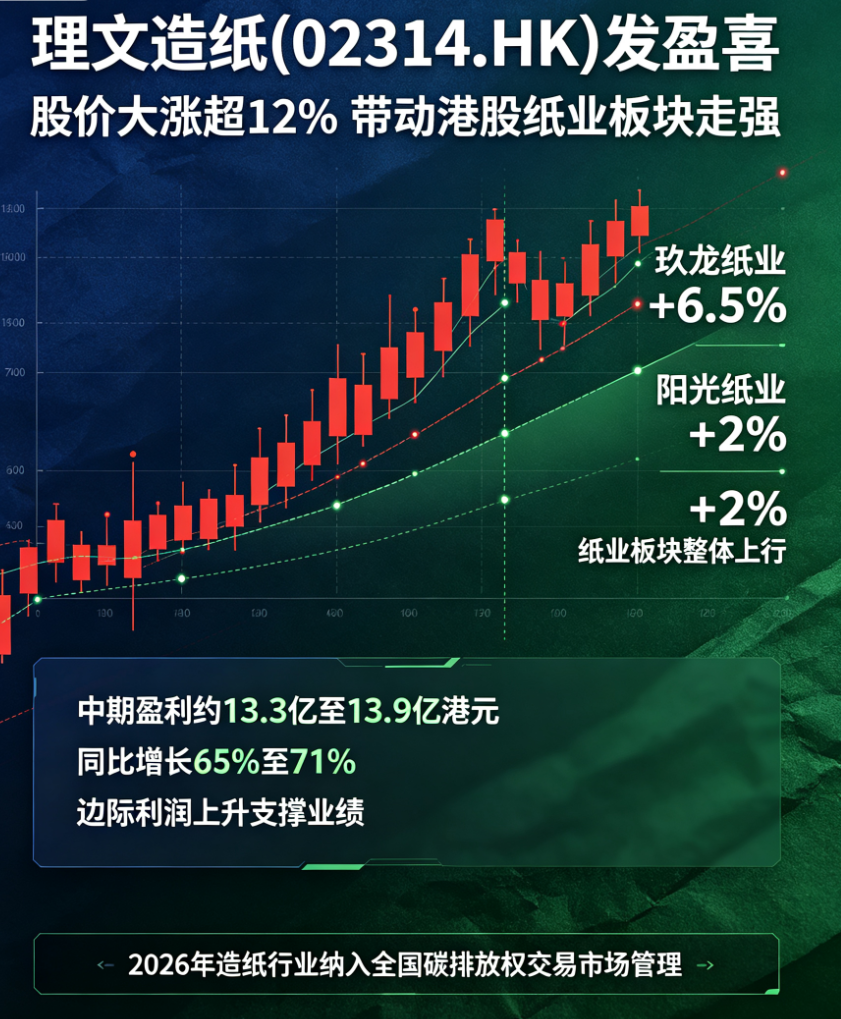
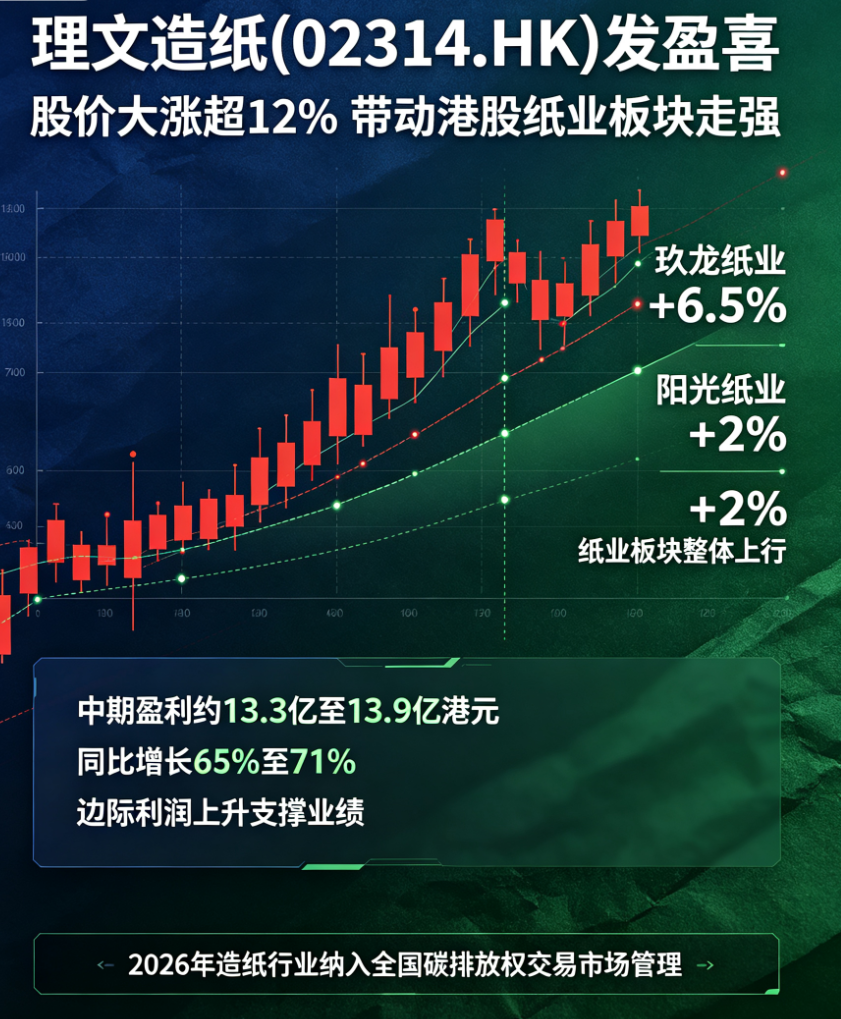
Recently, the Hong Kong paper sector has strengthened noticeably. Lee & Man Paper (02314.HK) surged more than 12% after issuing a profit alert, lifting Nine Dragons Paper by 6.5% and Sunshine Paper by over 2%. This was not a sentiment-driven move in a single name, but the result of earnings recovery across the industry, improved policy expectations and a marginal pickup in demand. For the paper industry, which has long been at a cyclical low, this rally means the market is re-pricing both the earnings elasticity of leading paper makers and the competitive landscape after future supply-side consolidation.
1. Profit alert sends a positive signal, and the market quickly re-rates industry sentiment
Lee & Man Paper's latest outlook indicates that interim profit for the six months ended June 30, 2026 is expected to be about HK$1.33 billion to HK$1.39 billion, up 64% to 71% year on year. This growth was well above market expectations, mainly because margins improved. For paper makers, profit recovery usually comes from two sides: higher paper prices or better product mix, and easing pressure from raw materials, energy and logistics costs. Lee & Man Paper's performance shows the industry is not relying solely on scale expansion to sustain growth, but is seeing real improvement in prices, costs and production-sales efficiency.
More importantly, the profit alert is acting as a bellwether for the sector. Hong Kong paper stocks are typically highly cyclical, and investors are very sensitive to earnings changes. When a leading company first delivers results above expectations, the market often quickly prices in the possibility of a higher industry earnings base, which in turn drives valuation rerating across peers. The simultaneous gains in Nine Dragons Paper and Sunshine Paper reflect this sector-wide linkage effect.
2. Expectations of carbon emission control inclusion strengthen the supply-side logic
Beyond earnings, policy changes are another important catalyst for this move. Under the relevant plan, the paper industry will officially be included in the national carbon emissions trading market in 2026. If the carbon policy is successfully implemented, competition within the industry could change profoundly.
The paper industry is inherently energy-intensive and resource-intensive. Once carbon constraints tighten, companies face not only direct compliance costs, but also a series of investments in environmental upgrades, energy-use control and equipment replacement. For small and mid-sized firms, these costs are often harder to turn into a competitive advantage; instead, they may accelerate the exit of inefficient capacity. By contrast, leading companies with scale advantages, cost-control capabilities and integrated pulp-and-paper layouts are better positioned to absorb policy shocks through internal coordination, energy management and supply-chain integration, and may even turn them into new barriers to entry.
From a medium- to long-term perspective, this suggests that the supply side of the industry may continue to improve. Over the past few years, the paper industry has often faced overcapacity and frequent price wars, which caused large swings in profitability. If carbon constraints truly take effect, low-end duplicate investment will be curbed, industry concentration is likely to rise, and the bargaining power and earnings stability of leading paper makers will improve accordingly. For capital markets, this kind of policy-driven supply-side clearing often provides stronger valuation support than short-term demand fluctuations.
3. The third quarter brings a shift from low season to peak season, and demand recovery has a real basis
On the demand side, the third quarter is the traditional transition period between low and peak seasons. As stocking for the Mid-Autumn Festival and National Day holidays gradually starts, demand for packaging paper, printing and writing paper and related downstream paper products is likely to be released from mid- to late-August. Although the pace of end-demand recovery still needs to be watched, in terms of order flow, pre-peak replenishment usually appears before actual consumption data and can therefore catalyze paper prices and operating rates.
For paper makers, the key to demand recovery is not just sales growth, but whether industry inventories can be successfully drawn down and whether prices can be supported by a new supply-demand balance. If orders recover in downstream packaging, logistics, e-commerce, food and beverage sectors, and mills become more willing to schedule production, paper prices may continue to recover. Meanwhile, if raw materials remain relatively stable, corporate profit elasticity will expand further.
It should be noted that demand improvement in the paper industry is usually not a linear rise, but a process of phased recovery plus inventory rebuilding. Therefore, the market is more focused on marginal changes than on absolute figures. The current sector rally is precisely a reflection of investors pricing in peak-season expectations ahead of time.
4. The advantages of leading companies become more prominent, and industry divergence may deepen further
In the new industry environment, the market's focus has shifted from simple capacity scale to comprehensive cost control, product mix and integrated layout. Led by Lee & Man Paper and Nine Dragons Paper, the leading companies share common strengths: stronger raw-material procurement power, a more complete industrial chain layout and higher operating efficiency. Faced with paper-price volatility and environmental constraints, these companies are better able to maintain profit resilience.
For small and mid-sized mills, the challenges ahead may be more direct. On the one hand, carbon costs and environmental investment will continue to raise the operating threshold; on the other hand, if demand recovery is insufficient, smaller companies will find it hard to spread fixed costs over scale, and profit margins may be squeezed further. It is therefore possible that competition will gradually shift from homogeneous expansion to concentration driven by efficiency and compliance. This will not only help leading companies increase market share, but also help the industry move away from low-level internal competition.
From an investment perspective, the core logic for the paper sector is no longer just a short-term bet on paper prices, but a combination of supply-side optimization and revaluation of leading companies. Whoever gains advantages in environmental compliance, cost control, pulp-paper synergy and customer structure is more likely to earn excess returns in the next cycle.
5. What this rally tells us: a window where cyclical recovery meets policy tailwinds
Overall, the sector rally triggered by Lee & Man Paper's profit alert is not an isolated event, but the result of resonance among industry fundamentals, policy expectations and market sentiment. At least three signals are being sent: first, industry profitability is gradually recovering from the bottom; second, carbon constraints may drive inefficient capacity out of the market; and third, third-quarter peak-season expectations will support near-term demand.
Against this backdrop, the paper sector may have entered a window where cyclical recovery and policy tailwinds overlap. Of course, investors still need to watch several key variables: whether paper prices can continue to rise; whether raw-material costs remain stable; the pace and intensity of carbon policy implementation; and whether the macro consumption recovery can continue to transmit into end-market demand. If these variables all move in a favorable direction, both the earnings base and valuation levels of leading paper makers could rise further.
Conclusion
In short, Lee & Man Paper's profit alert not only sent its own share price sharply higher, but also reignited market attention on Hong Kong paper stocks. Earnings improvement, the prospect of carbon emission control inclusion and the release of peak-season demand together form the three pillars behind this rally. For the industry, future competition will rely more on scale, efficiency and compliance capability; for capital markets, the investment thesis for paper stocks is shifting from traditional cyclical thinking to a focus on high-quality supply-side clearing and rising concentration among leaders.
If policy implementation proceeds smoothly and demand recovery continues, the paper industry is likely to enter a clearer recovery phase. At that point, companies with true pulp-and-paper integration and scale-based cost advantages may become the biggest beneficiaries of this industry transformation.