Southbound Funds Continue to Increase Holdings in HK Stock Connect Constituents: Shareholding Ratio Nears 20%, A+H Shares and Sector Leaders Become Core Allocations
Keywords: Southbound funds, Stock Connect, shareholding ratio, A+H shares, healthcare, industrials, financials
Introduction
Against the backdrop of the continued deepening of the mutual access mechanism, Southbound funds have gradually evolved from a “marginal increment” into a structural force that cannot be ignored in the Hong Kong stock market. As mainland investors gain easier access to Hong Kong stocks, Southbound funds are not only affecting liquidity at the trading level, but are also increasingly shaping clear patterns in pricing, valuation and sector preference.
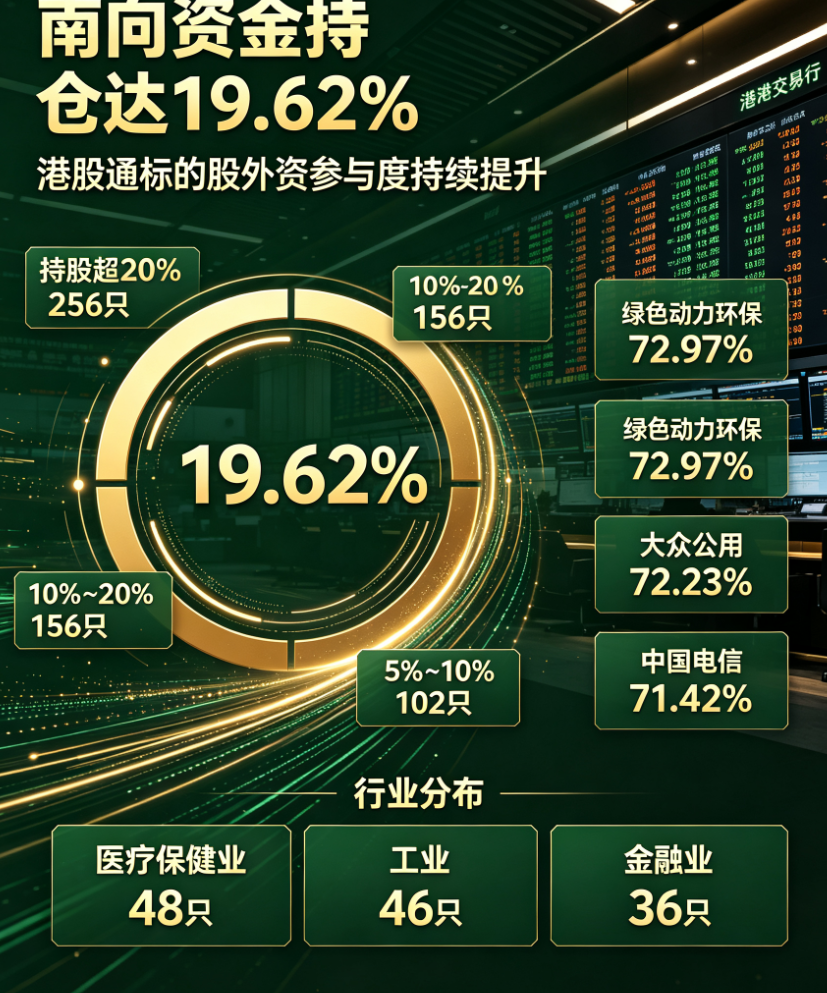
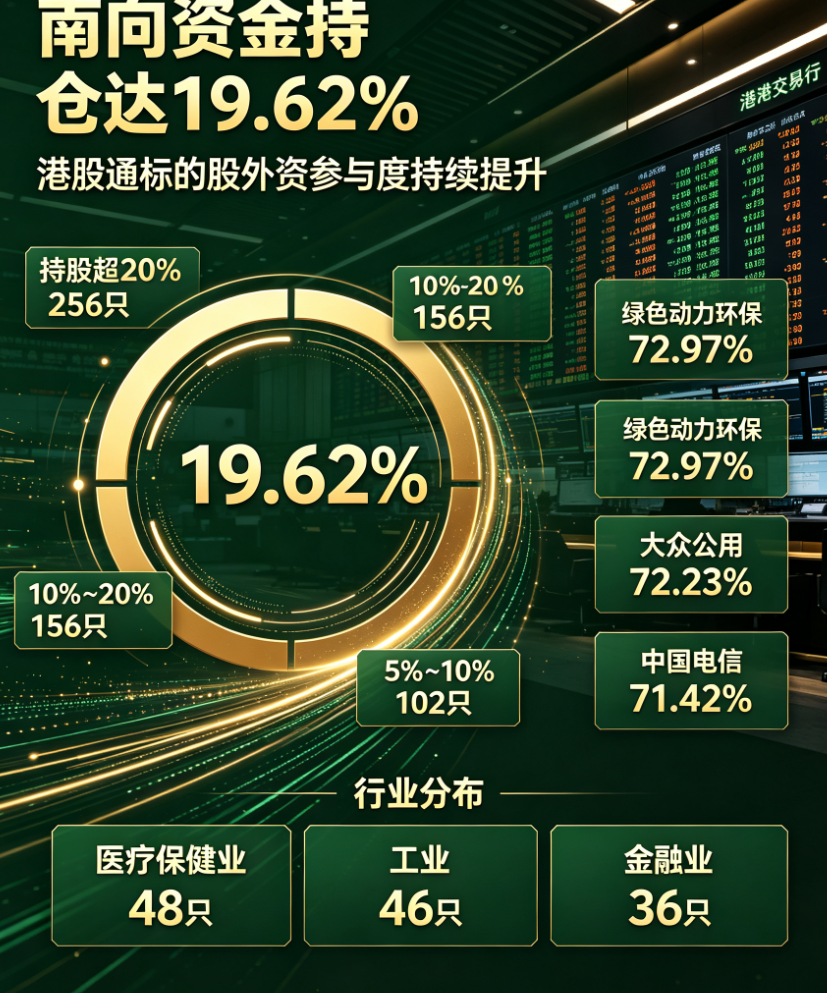
Securities Times·Data Treasure statistics show that as of July 20, Southbound funds held a total of 503.781 billion shares among HK Stock Connect constituents, accounting for 19.62% of their total outstanding shares; the total market value of holdings was nearly HK$5.95 trillion, or 14.55% of the total market value of these stocks. These figures mean Southbound funds have moved from being a “participant” to an “important pricing force” for HK Stock Connect constituents, especially in some individual stocks and sectors where their shareholding ratio is already close to or even above a controlling threshold.
1. Overall Holdings Rise, Southbound Influence Keeps Strengthening
In aggregate, Southbound funds’ shareholding ratio in HK Stock Connect constituents has approached 20%, showing that mainland capital is steadily increasing its allocation to the Hong Kong market. Unlike the early “trial allocation” phase, Southbound funds now prefer medium- to long-term holdings, with a clear concentration in stocks offering high dividends, reasonable valuations and stable industry positions.
On the one hand, the Hong Kong market has long traded at a valuation discount, and Southbound funds can use the mutual access mechanism to allocate high-quality assets at low cost, improving portfolio cost-effectiveness; on the other hand, as the share of mainland institutional investors rises, allocation logic has become more mature. Hong Kong stocks are no longer just an “arbitrage market,” but are increasingly seen as an important gateway connecting China’s core assets with global capital.
In terms of holding value, Southbound funds collectively held nearly HK$5.95 trillion in market value, showing that they are not merely short-term traders in a few thematic stocks, but have formed a broad-based, highly persistent Hong Kong stock allocation system. This shift has had a profound impact on the capital structure, trading habits and even valuation floor of the Hong Kong market.
2. 256 Stocks with Holdings Above 20%, High-Ratio Holdings Are Evident
At the single-stock level, 256 constituents have a Southbound shareholding ratio above 20%; 156 are in the 10%–20% range; 102 in the 5%–10% range; 88 in the 1%–5% range; and only 31 are below 1%. This shows Southbound positions in HK Stock Connect constituents are not scattered randomly, but display a clear tiered structure, with a considerable number of stocks held at high ratios.
The stock with the highest Southbound shareholding ratio is Dynagreen Environmental Protection, with the latest holding at 295 million shares, representing 72.97% of Hong Kong listed shares; second are DaZhong Public Utilities and China Telecom, with shareholding ratios of 72.23% and 71.42%, respectively. These stocks share common traits: either strong utility characteristics, stable cash flow and strong dividend appeal, or high operational certainty within their industries.
This also shows that Southbound allocation is not simply a chase for high growth, but places greater emphasis on fundamentals, earnings stability and a margin of safety in valuation. For the Hong Kong market, stocks with high Southbound ownership often become “pricing anchors”; once capital continues to flow in, their valuation floor is usually easier to support.
3. A+H Stocks Are a Key Allocation Direction, and Discount Re-Rating Logic Remains Intact
From a structural perspective, A+H stocks occupy an important place among the stocks held at high ratios by Southbound funds. Statistics show that among stocks with Southbound ownership above 20%, there are 148 A+H shares, accounting for 57.81%; among stocks with shareholding ratios of 10%–20%, A+H shares also account for 21.15%.
The reason A+H shares are favored lies mainly in their dual-listing status, relatively high transparency of performance, and strong concentration of industry leaders. For mainland investors, A+H shares make it easier to understand business models and valuation logic, and to compare them horizontally with similar A-share companies. Therefore, when Hong Kong valuations are clearly below those of A-shares, Southbound funds often prioritize this type of asset, creating a strong expectation of “discount re-rating.”
In addition, A+H shares are concentrated in mature sectors such as financials, energy, consumer, healthcare and industrials, with relatively controllable earnings volatility and stronger dividend capacity, which fits well with Southbound funds’ preference for steady returns. In other words, A+H shares are becoming a major “battleground” for Southbound funds entering the Hong Kong market.
4. Sector Distribution Is Concentrated, with Healthcare, Industrials and Financials Most Watched
According to HKEX sector classification, the stocks with Southbound shareholding ratios above 20% are mainly concentrated in healthcare, industrials and financials, with 48, 46 and 36 stocks respectively. This distribution reflects a clear defensive and leader-driven preference at the sector level.
Healthcare offers long-term growth potential and strong policy sensitivity. Once a quality company builds barriers in technology, branding or channels, it often attracts sustained capital attention; in industrials, many companies have stable orders, manufacturing advantages and global footprints, making them suitable for long-term allocation; financials remain a traditional core segment of the Hong Kong market, with low valuations, stable dividends and good liquidity, naturally matching Southbound allocation logic.
Further, Southbound funds’ preference for these sectors shows that they are not only focused on “low valuations,” but on “the certainty behind low valuations.” Against a backdrop of frequent changes in the pace of economic recovery, interest-rate conditions and market style, sectors that can provide stable cash flow and relatively high dividend returns are often more likely to receive continued overweighting.
5. Southbound Allocation Logic Is Reshaping the Hong Kong Stock Ecosystem
The increase in Southbound holdings of HK Stock Connect constituents is not just a matter of capital flows; it is an important signal of a restructured Hong Kong stock ecosystem. As shareholding ratios keep rising, Southbound funds’ influence on individual stock pricing, sector rotation and market sentiment continues to strengthen.
For investors, this shift sends several important signals: first, core assets in the Hong Kong market are being repriced, and quality leaders and high-dividend assets are more likely to attract capital; second, A+H shares and companies with stable fundamentals remain a key focus of long-term Southbound allocation; third, funds are not chasing short-term high beta, but rather sustainable medium- to long-term returns, meaning the Hong Kong investment logic is shifting from “event-driven” to “value-driven.”
Over a longer horizon, continued Southbound inflows are expected to improve the liquidity structure of the Hong Kong market, raise the valuation floor of quality assets, and encourage more mainland investors to use Stock Connect for global allocation. For the Hong Kong market, this is both incremental capital and an upgrade in the pricing system.
Conclusion
Overall, as of July 20, Southbound funds’ shareholding ratio in HK Stock Connect constituents had reached 19.62%, close to 20% of total outstanding shares, highlighting their important position in the Hong Kong market. 256 stocks have Southbound shareholding ratios above 20%, with A+H shares dominating, while healthcare, industrials and financials are the main sector concentrations.
This indicates that Southbound allocation has gradually shifted from a broad, scattershot approach to concentrated holdings in quality leaders, stable cash-flow businesses and valuation-advantaged assets. Looking ahead, as the mutual access mechanism continues to improve, Southbound funds are expected to remain an important stabilizer and value discoverer in the Hong Kong market, and structural opportunities in Hong Kong stocks will increasingly center on these core assets that keep attracting additions.