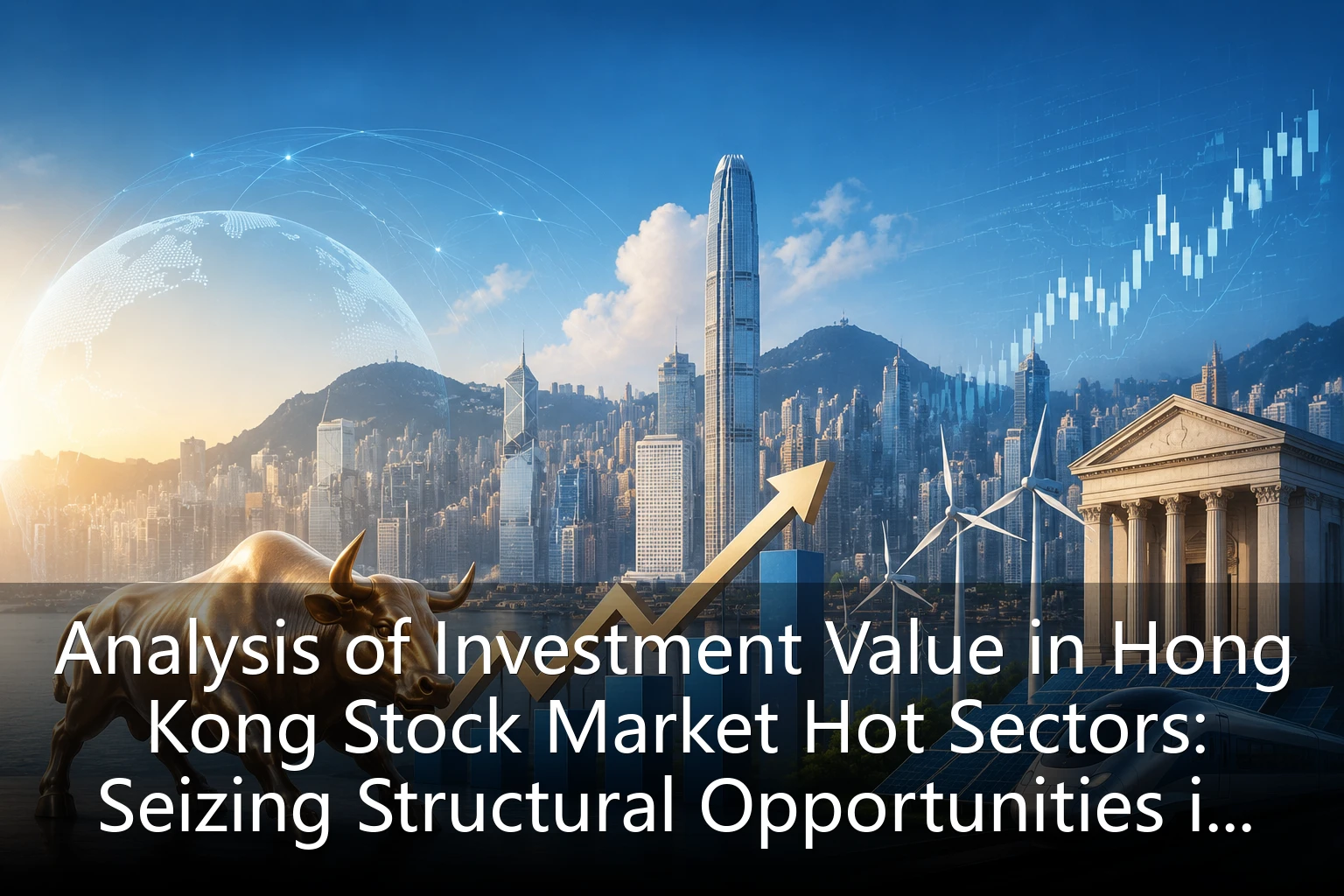
Analysis of Investment Value in Hong Kong Stock Market Hot Sectors: Seizing Structural Opportunities in the Hong Kong Market
Against the backdrop of continuously evolving global economic landscape, the Hong Kong stock market, as an important bridge connecting mainland China with international capital, is increasingly highlighting its investment value. In August 2026, the Hong Kong stock market has shown clear sector rotation characteristics, with differentiated performance across different industry sectors, providing investors with abundant structural opportunities. This article will conduct an in-depth analysis of the investment value of current hot sectors in the Hong Kong stock market, helping investors grasp market dynamics and formulate scientific investment strategies.
I. Overview of the Hong Kong Stock Market: A Safe Haven for Global Capital
Since 2026, the Hong Kong stock market has performed impressively among major global stock indices, with the Hang Seng Index consolidating around the 24,000-point mark. This performance is mainly attributed to three advantages of the Hong Kong stock market: first, valuation advantage, compared with the A-share market, Hong Kong stocks as a whole have more attractive valuations; second, high degree of internationalization with strong capital mobility; third, diversified industry structure covering the entire industry chain from traditional finance to emerging technology.
The continuous inflow of southbound funds is an important driving force for the strengthening of the Hong Kong stock market. Data shows that since 2026, Hong Kong Connect funds have recorded net inflows for consecutive days, with a cumulative scale exceeding 100 billion Hong Kong dollars. This indicates that mainland investors' confidence in the Hong Kong stock market is continuously growing, providing sufficient liquidity support for the market.
II. In-depth Analysis of Hot Sectors in the Hong Kong Stock Market
1. Technology Sector: AI and Cloud Computing Leading Growth
The technology sector is one of the main leading trends in the Hong Kong stock market in 2026. With the acceleration of commercialization of artificial intelligence technology, companies in related industrial chains such as AI servers, cloud computing, and big data are sought after by the market. Internet giants represented by Tencent Holdings and Alibaba are continuously increasing R&D investment in AI, with the proportion of related business revenue continuously increasing, injecting new momentum into company performance growth.
From an investment perspective, the long-term growth of the technology sector has relatively high certainty. On one hand, the digital transformation trend is irreversible, and corporate demand for cloud services and AI technology will continue to grow; on the other hand, valuations of Hong Kong technology stocks are relatively reasonable, with a higher safety margin. Investors can focus on companies with core technical advantages and stable cash flows, especially those that have achieved commercial implementation in AI application fields.
2. New Energy Sector: Dual Drive of Policy and Exports
The new energy sector is another major hot area in the Hong Kong stock market. Driven by global carbon neutrality goals, the new energy industry chain is facing development opportunities. Particularly, sub-sectors such as new energy vehicles, energy storage, and photovoltaics have shown outstanding performance. Continuous policy support has provided strong backing for the new energy sector, and mainland new energy vehicle export data has reached a new high, with impressive performance of related industrial chain companies.
It is worth noting that obvious differentiation has already emerged within the new energy sector. Leading companies with technical advantages and scale effects continue to receive capital favor, while some small and medium-sized enterprises lacking competitiveness face elimination risks. Investors should focus on links in the industrial chain with core competitiveness, such as leading enterprises in battery technology, intelligent driving, and other fields.
3. Financial Sector: Dual Advantages of Low Valuation and High Dividends
As a traditional heavyweight sector in the Hong Kong stock market, the financial sector has shown strong defensive characteristics in August 2026. Sub-sectors such as banking, insurance, and securities are at historical low valuations, while possessing stable dividend capabilities, attracting institutional capital seeking stable returns.
In terms of investment value, the attractiveness of the financial sector is mainly reflected in three aspects: first, valuations are at historical lows with a higher safety margin; second, relatively high dividend rates provide stable cash flow for investors; third, with economic recovery, the profitability of the financial industry is expected to improve. Investors can focus on financial institutions with good asset quality and diversified business structures, especially those leading in emerging areas such as wealth management and green finance.
4. Consumer Sector: Structural Opportunities Under the Upgrade Trend
The consumer sector is an important part of the Hong Kong stock market, covering multiple sub-sectors such as food and beverage, pharmaceuticals, and retail. With the increase in mainland residents' income levels and the continuation of the consumption upgrade trend, high-quality companies in the consumer sector have shown strong anti-risk capabilities and growth potential.
Within the consumer sector, obvious structural differentiation has emerged. On one hand, the growth rate of traditional consumer goods has slowed down with increasing competition; on the other hand, emerging consumption fields such as health consumption and experiential consumption are growing rapidly. Investors should focus on consumer leading companies that can accurately grasp the consumption upgrade trend, with brand advantages and channel control capabilities.
III. Risk Factors and Response Strategies for Hong Kong Stock Investment
1. Geopolitical Risks
Geopolitical factors are important variables affecting the Hong Kong stock market. Factors such as China-US relations and changes in policies between Hong Kong and mainland China may impact the market. Investors should closely follow relevant policy developments, reasonably control positions, and avoid excessive concentration in a single market or industry.
2. Exchange Rate Risks
The Hong Kong dollar's linked exchange rate system with the US dollar makes the Hong Kong stock market relatively sensitive to US dollar exchange rate fluctuations. Changes in RMB exchange rates will also affect the valuation level of Hong Kong stocks. Investors can use exchange rate hedging tools to reduce exchange rate risks, or choose companies with diversified income sources and less affected by exchange rates.
3. Liquidity Risks
Although the Hong Kong stock market has good overall liquidity, some small-cap stocks may still face insufficient liquidity problems. Investors should avoid excessively chasing hot small-cap stocks and prioritize large blue-chip stocks or ETF products with better liquidity.
IV. Investment Recommendations: Seizing Structural Opportunities and Building a Balanced Portfolio
Based on the analysis of hot sectors in the Hong Kong stock market, we propose the following investment recommendations:
- Diversified Asset Allocation: Reasonably allocate funds across different sectors such as technology, new energy, finance, and consumption to reduce single industry risks. Technology and new energy sectors are suitable for investors seeking higher growth, while finance and consumer sectors are more suitable for conservative investors.
- Focus on Leading Companies: Choose companies with core competitiveness and market leadership in various industries, as these companies usually have strong anti-risk capabilities and continuous growth potential.
- Grasp Sector Rotation Opportunities: The Hong Kong stock market shows obvious sector rotation characteristics. Investors should closely follow market capital flows and policy changes, and adjust their investment portfolio in a timely manner.
- Long-term Investment Perspective: The Hong Kong stock market has high volatility. Investors should establish a long-term investment philosophy, avoid frequent trading, and reduce transaction costs.
V. Conclusion
In August 2026, the Hong Kong stock market has shown clear sector rotation characteristics, with hot sectors such as technology, new energy, finance, and consumption each having investment value. Investors should build diversified investment portfolios based on their own risk preferences and investment goals to seize structural opportunities.
Overall, with its advantages of valuation, internationalization, and diversified industry structure, the Hong Kong stock market remains an important choice for global investors. As the interconnection between mainland China and Hong Kong capital markets continues to deepen, the investment value of the Hong Kong stock market will become more prominent. For investors seeking global allocation, seizing the structural opportunities in the Hong Kong stock market is expected to yield considerable investment returns.