Hong Kong’s IPO Market Keeps Booming in H1 2026, Even as Secondary-Market Sentiment Remains Fragile
Keywords: Hong Kong IPO, A+H listings, capital market, new economy, new quality productive forces, liquidity, high-dividend assets, stock market outlook
Introduction
As the first half of 2026 draws to a close, Hong Kong’s capital market presents a striking split picture. On the one hand, the secondary market has remained under pressure, with major indices repeatedly testing year-to-date lows amid weak risk appetite and global liquidity uncertainty. On the other hand, the primary market has continued to demonstrate remarkable vitality. New listings have accelerated, fundraising has remained robust, and Hong Kong is once again emerging as one of the world’s most active IPO hubs.
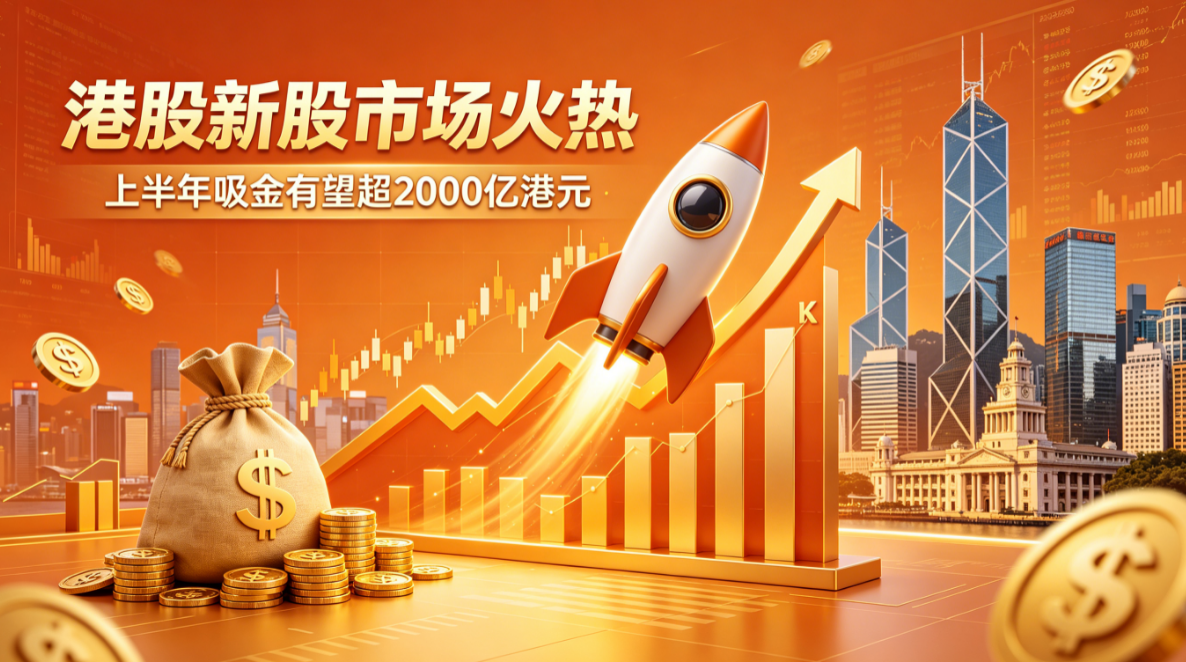
According to Wind data, Hong Kong is expected to see 83 companies complete IPOs in the first half of 2026, with total proceeds likely exceeding HK$208 billion. The scale of listings and fundraising has nearly doubled from the same period last year. In a week that has already seen multiple companies debut, the market is further underscoring the depth of its IPO pipeline. Industry observers believe Hong Kong’s new share market may set another high watermark this year, with full-year fundraising potentially placing the city among the global top three.
The contrast between a buoyant primary market and a subdued secondary market is not accidental. It reflects both structural changes in the mainland-Hong Kong capital linkage and the current mismatch between improving fundamentals and still-cautious investor confidence. Understanding this divergence is essential for assessing Hong Kong equities in the months ahead.
A Strong IPO Pipeline Continues to Support Market Activity
The latest wave of listings offers a useful snapshot of the current market landscape. On June 23, Hong Kong welcomed two new issuers: Syngen Biotech, a leading domestic dry-process separator company and already a listed firm in mainland China, and Huajian Future-B, a biotech company focused on autoimmune, metabolic, and oncology therapeutics. The latter’s pipeline includes three core self-developed, small-molecule, Category 1 innovative drugs, highlighting the type of high-quality, innovation-driven enterprises increasingly favored by investors.
This was not an isolated event. In the same week, seven more companies were scheduled to list in Hong Kong, including firms from robotics, biopharmaceuticals, industrial software, consumer electronics, and semiconductor-related sectors. Together with other recent debuts, ten companies are expected to complete IPOs within a single week. Such clustering illustrates not only strong issuer demand but also the exchange’s capacity to absorb a large volume of listings without losing momentum.
More broadly, Hong Kong’s IPO market in 2026 has benefited from several reinforcing factors. First, Chinese companies continue to seek broader financing channels and international visibility. Second, policy support on the mainland has encouraged high-quality industry leaders to consider overseas listings, especially in Hong Kong. Third, the city’s regulatory framework and market infrastructure remain attractive for firms seeking both global capital and proximity to Chinese investors.
These dynamics have made Hong Kong a preferred destination for companies pursuing “go global” strategies. For many issuers, a Hong Kong listing is no longer merely a financing event; it is a strategic step toward brand internationalization, governance enhancement, and access to a more diversified shareholder base.
A+H Companies and New Economy Firms Are Driving the Market
One of the clearest features of Hong Kong’s 2026 IPO market is the rising dominance of A-share listed companies. Among the 83 companies expected to list in the first half, 24 are already listed in mainland China, accounting for nearly 30% of the total. In fundraising terms, these A-share firms are expected to raise more than HK$121.7 billion, representing over 60% of overall proceeds.
This trend is highly meaningful. It shows that Hong Kong’s primary market is increasingly serving as an extension of the mainland capital market, especially for established companies seeking international capital, currency diversification, and strategic flexibility. For issuers such as consumer, industrial, and advanced manufacturing leaders, an “A+H” structure helps expand valuation visibility and improve long-term funding capacity.
At the same time, companies in emerging growth sectors continue to attract strong investor attention. A prime example is Shenghong Technology, which raised more than HK$20 billion and became the most heavily funded IPO in the first half. As a supplier of printed circuit boards for artificial intelligence and high-performance computing, the company is positioned in a high-growth segment that spans AI servers, new energy vehicles, and high-speed communications.
This pattern reflects a broader market preference for “new quality productive forces” — companies tied to innovation, advanced manufacturing, digital transformation, and strategic technologies. In an era when investors are seeking earnings visibility and long-term growth narratives, such companies often command a premium valuation, even amid a cautious macro backdrop.
The market enthusiasm toward AI-related firms is especially notable. With the latest global technology cycle increasingly driven by artificial intelligence, Hong Kong investors have become more attentive to local companies with AI exposure. The inclusion of certain AI and deep-tech leaders in benchmark indexes has also helped improve the visibility of these themes. While Hong Kong’s tech weighting still lags some overseas peers, the market structure is gradually evolving.
Why the Secondary Market Remains Weak
Despite the strength of the IPO market, Hong Kong’s secondary market has not yet found a stable upward trend. Recent sessions have seen broad-based declines across the Hang Seng Index, Hang Seng China Enterprises Index, and Hang Seng TECH Index, with intraday moves repeatedly setting new yearly lows.
The weakness is partly attributable to liquidity pressures. As expectations for further U.S. rate hikes or a more hawkish Federal Reserve stance intensify, the U.S. dollar tends to remain firm. In such an environment, global liquidity conditions tighten, and capital tends to be more selective in allocating to emerging markets and Hong Kong-related assets.
This is particularly important for Hong Kong, whose capital market remains highly sensitive to international funding flows. A stronger dollar can slow the pace of capital rotation into risk assets, limit valuation expansion, and suppress the momentum of northbound and southbound flows. Market participants are therefore advised to remain alert to volatility triggered by hawkish signals from the Fed.
More fundamentally, however, the issue is not just liquidity. It is also a question of confidence. Several analysts believe that Hong Kong’s fundamental turnaround has already been established, but the market has not yet seen a convincing alignment between improving earnings expectations and renewed capital inflows. In other words, the macro bottom may be in sight, but the market bottom still requires confirmation through earnings recovery, policy transmission, and sustained risk appetite.
Outlook: Policy Support and Earnings Recovery Will Be Key
Looking ahead, Hong Kong equities may still have room for recovery if fundamentals continue to strengthen. China’s policy mix, including efforts to stabilize growth, boost domestic demand, and support innovation-oriented industries, should gradually feed into listed companies’ earnings. If profits begin to improve meaningfully, the market could shift from valuation-driven trading to a more durable earnings-and-valuation re-rating.
This is why many strategists are adopting a more balanced and selective approach rather than a broad bearish or bullish stance. In the short term, attention may be better directed toward oversold sectors with heavy short-selling pressure but stabilizing earnings expectations. High-dividend defensive assets, such as banks and certain media-related names, may also continue to serve as portfolio stabilizers.
Over the medium term, investors may look to sectors with accelerating industry momentum, including semiconductors, power equipment tied to the new energy transition, and industrial machinery. Some consumer staples and food-and-beverage names may also become more attractive as profit expectations stabilize and dividend characteristics improve.
By contrast, consumer services and other cyclical sectors may require clearer evidence of improvement in high-frequency macro data before a meaningful right-side entry point emerges. In a market where confidence is still rebuilding, timing and sector selection matter more than broad index exposure.
Conclusion
Hong Kong’s 2026 first-half market tells a story of two realities. The IPO market is vibrant, resilient, and structurally supported by the continued expansion of A+H listings, new economy enterprises, and policy-backed capital formation. Meanwhile, the secondary market remains restrained by external liquidity pressure and incomplete confidence recovery.
This divergence is not necessarily a contradiction. Rather, it reflects a transitional stage in which Hong Kong is deepening its role as a gateway for Chinese companies seeking international capital, while also waiting for stronger earnings momentum and a more favorable global monetary environment to reignite equity valuations.
For investors, the message is clear: Hong Kong remains a market worth watching, but selectivity is essential. The next phase of opportunity may not come from indiscriminate exposure, but from identifying companies and sectors where earnings resilience, policy support, and strategic growth themes converge.