Title: AI, Semiconductors, and the New Market Power Shift: What Monday’s Movers Reveal
Keywords: Micron, Apple, NVIDIA, Tesla deliveries, Amazon Redshift, semiconductor cycle, AI infrastructure, cloud computing, TSMC, Applied Materials
Introduction
Monday’s U.S. equity session offered more than a routine list of winners and losers. It provided a clear snapshot of where capital is concentrating in the current market cycle: artificial intelligence infrastructure, memory chips, advanced manufacturing equipment, and companies positioned to benefit from supply-side constraints. The day’s most actively traded names reflected a broader story of pricing power returning to hardware suppliers, demand for computing capacity remaining exceptionally strong, and investors shifting focus from narrative-driven speculation toward tangible operating data.
At the center of the discussion was Micron Technology, which rose after a public dispute with Apple over memory chip pricing. Nearby in the rankings were Nvidia, Tesla, Amazon, and Taiwan Semiconductor Manufacturing Company, each representing a different layer of the same investment theme: the race to build, power, and scale the next generation of computing systems. Taken together, these developments suggest that the market is no longer treating AI as a distant possibility. It is now pricing AI as an industrial engine reshaping margins, supply chains, and capital allocation across sectors.
Micron and Apple: A Pricing War That Signals a Cycle Turn
Micron’s move higher was not just a reaction to earnings or a product announcement. It was driven by a revealing dispute with Apple over storage chip pricing. Micron CEO Sanjay Mehrotra publicly argued that Apple had for years benefited from unusually low chip prices, citing a model in which chips bought for roughly $5 were resold in devices for around $99. He contrasted that with Micron’s recent attempt to raise pricing to $50, only to see Apple allegedly pass on a $250 increase to customers in its own products.
This exchange matters because it captures the essence of the current memory market. During periods of oversupply, large customers often dictate terms, forcing suppliers to cut prices and preserve volume. But when demand tightens and fabrication capacity becomes scarce, the balance of power shifts. Apple’s recent announcement of large price increases across Mac and iPad products, reportedly up to $300, suggests that downstream pricing flexibility still exists at the device level. Yet Micron’s response implies that upstream suppliers no longer intend to absorb the full burden of inflation, especially when AI-related demand is absorbing memory and storage capacity.
The deeper issue is investment discipline. Micron’s Chief Business Officer Sumit Sadana hinted that some customers compressed pricing during the last industry downturn, helping to undermine sector profitability and reduce incentives for capacity expansion. Now, with demand rebounding and supply constrained, those same customers are facing the consequences of a thinner inventory buffer and tighter market conditions. In that sense, this is not simply a dispute between two corporate giants. It is an illustration of a memory industry that has moved from buyer’s market to seller’s market, with pricing power returning to producers who endured years of volatility.
AI Infrastructure Is Broadening Beyond Nvidia
Nvidia remains one of the market’s most important AI beneficiaries, but the latest news suggests that the AI buildout is becoming broader and more complex. Reports indicated that Cerebras will provide OpenAI with a total of 750 megawatts of computing support. That scale is extraordinary, roughly comparable to the power demand of a large data center campus. Such a deployment is significant not only for its size but also for what it implies: leading AI developers are now planning for massive inference capacity, not just model training, and are increasingly willing to diversify beyond a single dominant supplier.
For Nvidia investors, this is not necessarily negative. In fact, it may reinforce the overall size of the opportunity. If OpenAI and other frontier AI firms are expanding infrastructure at this scale, the total addressable market for AI compute continues to grow. However, it also suggests that competition is intensifying across the stack—from accelerators and memory to networking, cooling, and power management. The AI economy is becoming less about one chip vendor and more about a full industrial ecosystem.
That is why Micron, Applied Materials, TSMC, and even power-intensive infrastructure players are all being pulled into the same investment narrative. The bottlenecks are shifting. In earlier stages of the AI boom, the market focused primarily on GPUs. Now investors are paying closer attention to the supporting layers that determine whether the infrastructure can actually scale. Memory bandwidth, advanced packaging, fabrication equipment, and power availability are no longer secondary concerns; they are central constraints.
Tesla: Deliveries, Not Demos, Will Decide the Story
Tesla’s sharp rise on the day reflected optimism, but the next major catalyst is likely to be much more concrete: second-quarter delivery data, expected in early July. For all the attention surrounding autonomous driving, robotaxis, and humanoid robots, Tesla’s quarterly vehicle deliveries remain the most direct measure of whether demand for its core automotive business is recovering.
That focus is understandable. In 2025, Tesla delivered 1,636,129 vehicles, an 8.6% decline from nearly 1.8 million in 2024. In the first quarter of 2026, deliveries rose 6.3% year over year to 358,023, indicating a return to growth. Yet production exceeded deliveries by roughly 50,000 vehicles, a gap larger than usual and one that raises questions about inventory, demand absorption, and channel balance.
Wall Street currently expects second-quarter deliveries of about 406,000 vehicles, with more optimistic forecasts reaching approximately 420,000. Either result would exceed the 384,122 vehicles delivered in the same quarter last year, making the year-over-year comparison a key test of whether Tesla’s recovery is durable. If the company meaningfully beats expectations, it could reinforce the idea that demand is stabilizing after a difficult period. If not, the market may continue to treat valuation multiples tied to futuristic narratives with caution.
This is why Tesla’s stock remains so sensitive to delivery data. Investors may be intrigued by the company’s long-term optionality in autonomous systems, robotics, and energy, but near-term share performance still depends heavily on the health of the core vehicle business. In a market increasingly selective about profitability and execution, Tesla will need more than ambition; it will need consistent operational proof.
Cloud and Data Infrastructure: Amazon’s Quiet but Important Upgrade
While much of the market attention centered on hardware and EVs, Amazon also drew interest after Amazon Web Services introduced several new capabilities for Redshift. The upgrades emphasize multi-cluster performance, elastic scaling, and a more decentralized high-performance analytics architecture. Among the most notable enhancements are support for remote materialized views, remote table DDL operations, and improved concurrency for zero-ETL and S3 event integration.
These features may sound technical, but their strategic value is clear. Enterprises increasingly want analytics systems that can scale without forcing data movement or disrupting production workloads. The ability to create materialized views from remote clusters and external sources can reduce compute costs and improve query speed. Remote table structure changes allow distributed teams to manage large environments without data duplication. Better concurrency for zero-ETL pipelines helps organizations separate analytical demand from core operations, a critical requirement as real-time decision-making becomes more important.
Amazon’s move highlights an important truth about the AI era: value is not created solely by model training. It is also created by the data infrastructure that feeds inference, analytics, and enterprise applications. As companies adopt more AI-driven workflows, they need cloud systems that are both flexible and resilient. Amazon is positioning Redshift as part of that foundation.
The Capital Expenditure Wave Is Reaching Equipment Makers
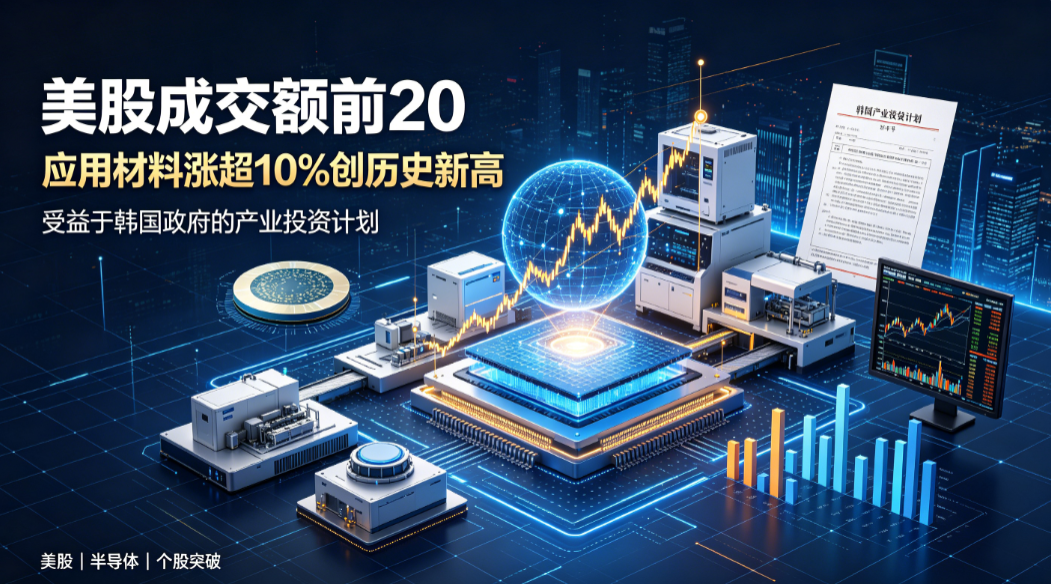
Applied Materials surged after South Korea unveiled its largest-ever semiconductor and AI investment plan. Under the initiative, the government will invest heavily in chip factories and related industrial capacity, with Samsung and other contractors expected to play central roles. The long-term goal is to double DRAM production capacity within five years.
For equipment suppliers, the logic is straightforward: every new fab requires machines before it can produce wafers. That means front-end equipment makers benefit directly from new capacity builds, while back-end equipment suppliers also gain as advanced chips require increasingly sophisticated packaging and testing. Applied Materials’ rally reflects the market’s growing recognition that the AI boom is driving not only chip demand, but also a new capex supercycle.
Taiwan Semiconductor Manufacturing Company is likewise positioned to benefit from this environment. Analysts recently raised TSMC’s target price and maintained a bullish rating, citing expectations for continued sales growth through the next several years. Forecasts now suggest the company could begin raising product prices in 2027, adding another layer of margin expansion. More importantly, TSMC is expected to increase capital spending through 2026 to 2028, supporting the expansion of capacity across CPU, AI, and edge-intelligence markets.
This is not merely a cyclical rebound. It is a structural investment phase. As AI demand intensifies and customers seek more diversified supply chains, leading foundries and equipment vendors are likely to remain in the capital allocation spotlight.
Conclusion
Monday’s market leaders tell a coherent story. Micron’s dispute with Apple underscores the return of pricing power to memory suppliers. Nvidia’s trading strength reflects continued enthusiasm for AI compute, even as supply chains diversify. Tesla’s upcoming delivery report will determine whether its recovery in core vehicle demand is real or temporary. Amazon’s Redshift upgrades show that cloud infrastructure is adapting to the next phase of enterprise analytics, while Applied Materials and TSMC stand to benefit from the capex wave now building across Asia and the broader semiconductor industry.
The common thread is a shift from narrative to infrastructure. Investors are no longer just betting on what AI might become; they are increasingly rewarding the companies that build, power, store, and scale it. In this environment, the winners are likely to be those with real pricing power, strong execution, and a position somewhere near the bottlenecks that define the next industrial cycle.