Introduction: The "Cold" and "Hot" at the 24,000-Point Mark of the Hang Seng Index
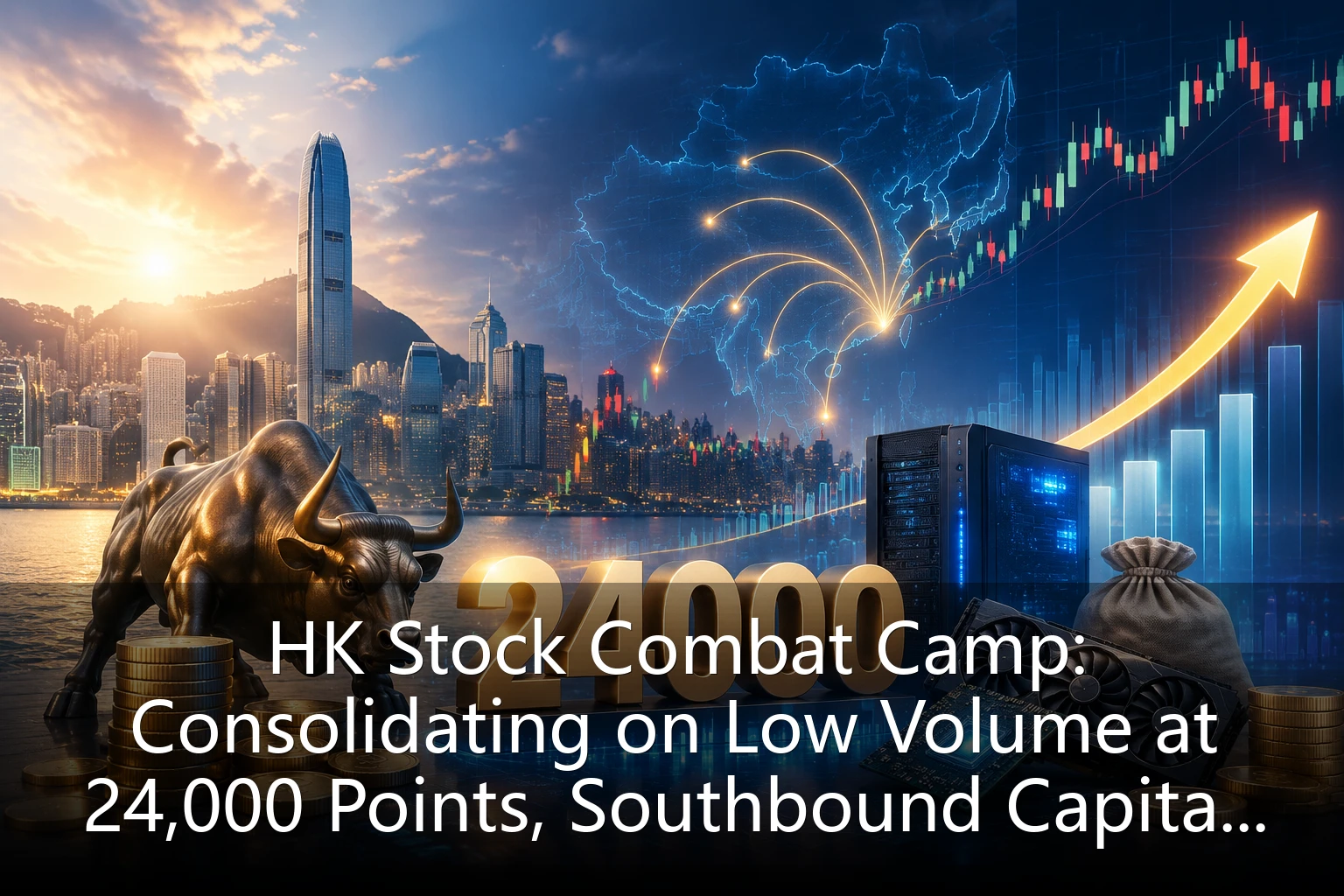
Entering early August 2026, after experiencing an intermediate rebound, the HK stock market has once again arrived at a critical crossroads. The Hang Seng Index has repeatedly tussled around the 24,000-point integer mark, and overall market trading activity has cooled compared to the previous period, showing a typical low-volume consolidation trend. For ordinary investors, this "neither rising nor falling" volatile market is often the most agonizing stage—chasing highs fears being trapped, while bottom-fishing fears catching a falling knife. However, in a professional HK stock trading system, the volatile period is precisely the golden window to identify main capital intentions, adjust positions, and lay out the next market phase.
As part of the series analysis of the "Stock Discourse" HK Stock Combat Camp, this article will put aside the complicated noise and directly address the core contradictions of the current HK stock market. Starting from three dimensions: macro liquidity expectations, order book capital game details, and industry sector rotation logic, we will deeply dismantle the current market's operating context. We will also focus on how to build a barbell-style practical strategy of "high-dividend defense + AI hardware offense" under the background of continuous southbound capital buying, finally supplemented by strict position management and risk control systems to help investors find deterministic investment anchors in the current puzzle.
I. Macro Environment and Order Book Characteristics: The Truth of Capital Game Behind Low Volume
1. The Expectation Gap Between the US Dollar Cycle Turning Point and Foreign Capital Reflow
The core variable at the macro level recently still focuses on the continuous weakening of the US Dollar Index. As US inflation data showed a substantial decline in mid-2026, the market's expectation that the Fed will maintain an interest rate cut cycle has been further consolidated. The US Dollar Index breaking below previous key support levels has led global capital to reassess the allocation value of emerging markets. As an offshore market, HK stocks are extremely sensitive to USD liquidity. Theoretically, a weak US dollar will directly boost the valuation center of HK stocks, attracting foreign capital reflow.
However, from recent market observations, foreign capital reflow is not happening overnight but shows obvious "tentative" characteristics. The Hang Seng Index encountering resistance around 24,000 points is largely due to the need for more fundamental data verification (such as interim report performance) when foreign capital revalues Chinese assets. This results in the broader market lacking sustained incremental capital momentum when attempting to break through, forming a low-volume oscillation pattern.
2. Order Book Capital Game: The "Stabilizing Anchor" Role of Southbound Capital
Unlike the hesitation of foreign capital, southbound capital has recently shown extreme resilience. From real-time data on Stock Connect capital flows, despite market volatility, southbound capital has maintained a net inflow trend for consecutive days, and the buying directions are highly concentrated. This operation method of "buying on dips and adding positions during volatility" not only provides solid bottom support for HK stocks but also exposes the true intentions of main capital.
In practical order book watching, we focus on the performance of Hang Seng Index constituent stocks. The order book shows that whenever the Hang Seng Index experiences a rapid intraday drop, it always encounters strong support near key moving averages (such as the 20-day moving average), and the buying orders mainly come from high-dividend blue-chip stocks favored by domestic capital. This order book characteristic indicates that the current market's downside space is strictly blocked by southbound capital, and the intention of volatile wash-out is greater than distribution. In practical operations, investors should closely follow the pace of southbound capital to avoid being shaken out in the bottom area.
II. Sector Rotation Analysis: Seeking "Certainty" in a Volatile Market
In a low-volume volatile market environment, sector rotation speeds up significantly, and capital is more inclined to cluster in sectors with "certainty." The certainty in the current market is mainly divided into two categories: one is high-dividend assets with extremely strong defensive attributes, and the other is the AI hardware industry chain with high certainty in performance realization.
1. Defensive Cornerstone: The "Safe Haven" Logic of High Dividend Assets
Among popular HK stock sectors, the high-dividend strategy remains the main thread throughout the year. Since 2026, with the continuous decline in risk-free interest rates, the cost-effectiveness of high-dividend assets in HK stocks has become more prominent. From recent unusual movements in HK stock industry sectors, high-dividend sectors such as utilities, energy, telecom operators, and some major state-owned banks have shown extreme resilience during market corrections, even turning red against the market trend.
At the practical level, investing in high-dividend stocks is not simply finding targets with the highest static dividend yield. We need to be wary of the "high-dividend trap"—cyclical stocks where the dividend yield is passively pushed up due to a sharp stock price decline, but fundamentals are deteriorating and dividends are hard to sustain. The correct practical stock selection method should follow these principles:
- Cash Flow is King: Prioritize mature enterprises with abundant free cash flow and low capital expenditure pressure. These enterprises not only have the willingness to pay dividends but also the ability to maintain or even increase the dividend payout ratio.
- Stable Dividend Willingness: Examine the company's dividend history over the past five years, preferring companies with a dividend payout ratio (proportion of net profit) steadily above 30% and showing a gradual upward trend.
- Exclude Cycle Peaks: For strong cyclical industries (such as coal and shipping), assess their current cycle position. If at a cycle peak, the high dividend might be a "last hurrah" and should be avoided.
2. Offensive Weapon: The Performance Realization Period of the AI Hardware Industry Chain
If high dividends are the shield of defense, then AI hardware is the spear of offense. With the exponential growth in global AI large model training and inference demand, 2026 has become an explosive year for AI computing power infrastructure construction. From recently disclosed interim performance forecasts, targets in HK stocks involving AI servers, optical modules, liquid cooling equipment, and semiconductor foundries have generally shown better-than-expected growth.
In the rotation analysis of HK stock sectors, we noticed that the tech hardware sector has recently shown signs of capital reflow after a brief rest. Unlike the previous pure concept speculation, current capital pays more attention to performance realization capabilities. In practical stock selection, investors should focus on digging out core targets that possess core technical barriers in the AI industry chain, have entered global giant supply chains, and have full capacity utilization.
It should be noted that the volatility of tech stocks is much higher than that of high-dividend stocks. In practical operations, avoid blindly chasing highs. Technical pattern analysis can be used to buy on dips when the stock price pulls back to important support levels (such as the 60-day moving average or previous platform breakout levels) on low volume, to improve the safety margin of funds.
III. Practical Strategy Construction: Barbell Allocation and Position Management
Based on the above in-depth analysis of the market environment and sector rotation, aiming at the volatile market characteristics of the Hang Seng Index at the 24,000-point mark, we recommend a "barbell-style" asset allocation strategy for investors in the HK Stock Combat Camp. The so-called barbell strategy means heavily weighting defense on one end and offense on the other, balancing the portfolio's risk and return through polarized allocation at both ends.
1. Portfolio Construction Ratio
At the current stage where the market direction is not fully clear, it is recommended to control the total position at around 60%, retaining 40% cash as mobile funds. Within the 60% equity position, it is recommended to allocate it to high-dividend assets and AI tech hardware at a ratio of "6:4".
- Defensive End (60% Position): Allocate 3-4 high-dividend blue-chip stocks in different industries, such as telecom operators and utility leaders. This part of the funds pursues stable dividend income and anti-decline attributes, serving as the ballast of the entire account.
- Offensive End (40% Position): Allocate 1-2 core AI hardware targets with extremely high performance certainty. This part of the funds is used to capture excess returns and seize the dividends of the tech growth cycle.
2. Trading Rhythm and Capturing Intraday Reversal Opportunities
In a volatile market, individual stocks often show wide-range fluctuation characteristics, which provides space for intraday T+0 trading (limited to some short-sellable stocks among Stock Connect targets or hedging through options) or swing trading. Investors can combine HK stock intraday reversal opportunities, buying low during extreme intraday panic and selling high during sentiment peaks.
Practical tips: Pay close attention to the auction situation in the first 30 minutes of the morning opening. If a core target opens significantly lower due to peripheral news impacts, but does not continue to decline after opening, and shows signs of bottom-raising and gentle volume expansion on the intraday chart, this is often a good intraday low-buying point. Conversely, if it opens high and surges but fails to break the previous day's high, and large selling orders appear in the order book, one should decisively reduce positions at highs.
IV. Risk Control: Survival Always Comes First
In stock market practice, no matter how rigorous the logic is, without a strict risk control system, it will ultimately be eliminated by the market. Because the HK stock market features T+0 trading, no price limit rules, and short-selling mechanisms, its volatility intensity is much higher than A-shares, making risk control particularly crucial.
1. The Art of Stop-Loss: Cut Losses Short, Let Profits Run
For high-dividend defensive positions, stop-loss standards can be appropriately relaxed, using the break of core logic (such as major adverse changes in dividend policy) or long-term trend lines at the weekly level as the stop-loss basis. As for AI tech offensive positions, ironclad mechanical stop-losses must be executed. It is recommended to set a hard stop-loss level 8% to 10% below the purchase price. Once triggered, execute unconditionally, and never harbor a fluke mentality.
2. Avoid Liquidity Traps and "Penny Stock" Minefields
The HK stock market has a large number of penny stocks and micro-cap companies. These stocks often have extremely poor liquidity and may even have capital operations such as reverse stock splits that harm the interests of minority shareholders. In practice, one must stick to the principle of "liquidity first" and resolutely avoid marginal individual stocks with an average daily trading value of less than 10 million HKD. In addition, companies that frequently conduct rights issues and stock consolidations should be blacklisted entirely.
3. Watch for Unusual Movements and Volume Anomalies
In the process of daily market watching, pay high attention to HK stocks with abnormal trading volumes. If a stock suddenly surges on heavy volume without substantial positive news, it is often accompanied by wash trading for distribution or insider trading; conversely, if it suddenly breaks down on heavy volume after a high-level low-volume consolidation, it is a signal of main capital fleeing. Investors need to perceive the true intentions behind the order book through price-volume relationships.
V. Conclusion: Patiently Wait for the Arrival of the Breakout Point
In summary, the HK stock market in August 2026 is in a consolidation period with a "ceiling above and a floor below." The offense and defense battle at the 24,000-point mark of the Hang Seng Index is not only a contest between long and short capital but also a market re-examination of macroeconomic expectations and corporate earnings fundamentals. For investors, what is needed now is not blindly predicting short-term market fluctuations, but down-to-earth stock selection and risk control.
By building a barbell strategy of "high dividend + AI hardware" and supplementing it with strict position management, we can not only maintain our mindset in a volatile market but also seize the initiative in future breakout markets. Investment is a marathon, competing not in momentary explosive power, but in the enduring survival ability to cross bull and bear cycles. In the Stock Discourse HK Stock Combat Camp, we will continue to track market capital movements for you, dig deep into industry fundamental turning points, and steadily move forward with you in the unpredictable HK stock market, waiting quietly for the flowers to bloom.