USD Cycle Turning Point Confirmed: HK Stocks Usher in Golden Node of Global Capital Reallocation
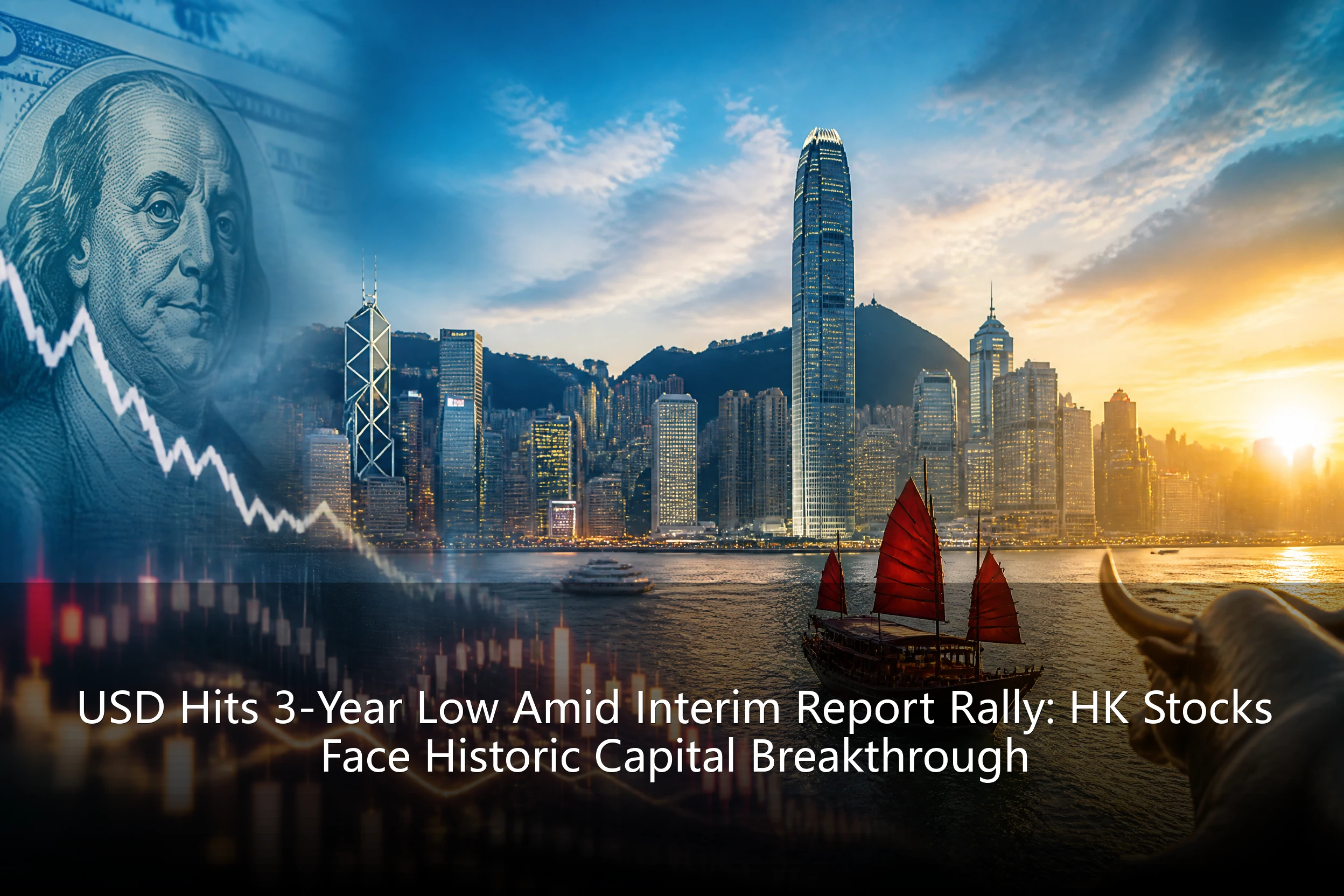
On August 7, 2026, a profound reversal of capital flows is unfolding on the global macroeconomic stage. As the latest US non-farm payroll data and inflation indicators consecutively release weak signals, the market's expectation for the Fed to cut interest rates within the year has evolved from a probabilistic event to a definitive consensus. The USD index has continued to fall in recent trading, hitting its lowest level in nearly three years. This major macro-level change is rapidly making waves in Asia-Pacific capital markets, and the Hong Kong stock market, as a global valuation depression, is at the absolute core of this capital reallocation storm.
For investors who have been following "why invest in HK stocks," the current market environment provides a textbook-level strategic allocation window. Due to its unique "offshore + onshore" dual attributes, the HK stock market is extremely sensitive to changes in USD liquidity. The continuous weakening of the USD index not only directly alleviates the exchange rate depreciation pressure faced by the HKD but also fundamentally breaks the "strong USD" curse that has suppressed HK stock valuations for years. When risk-free yields begin a downward trend, massive global profit-seeking capital will inevitably seek out yield depressions again, and the Hang Seng Index's current P/E ratio of less than 10x undoubtedly constitutes a highly attractive safety margin.
Weak USD Cycle Begins: The Underlying Logic of Foreign Capital Returning to HK Stocks
Reviewing market trends over the past few years, a strong USD was the Sword of Damocles hanging over the HK stock market. High US Treasury yields forced massive overseas long-term funds to withdraw from emerging markets and flow back to the US. However, entering the second half of 2026, this logic is being completely reversed. As the Fed's interest rate cut is about to land, the inverted spread between China and the US has significantly narrowed, meaning the opportunity cost of holding HK stocks is drastically reducing.
From the perspective of capital gaming, foreign capital's allocation to HK stocks is currently in the initial stage of recovering from underweight to standard weight. We see that the Hang Seng Index has shown extremely strong resilience around 23,500 points recently; this is no accident, but a trading characteristic of long-term funds quietly entering the market. Compared to the A-share market, HK stocks implement a linked exchange rate system, pegging the HKD to the USD. In a USD rate-cut cycle, HKD assets can not only enjoy the dividends of valuation restoration but also avoid the risk of emerging market currency depreciation. This "offensive and defensive" characteristic is the primary advantage of investing in HK stocks right now.
Interim Performance Rally Intensively Erupts: Fundamental Restoration Drives Valuation Reassessment
If the weak USD provides upward valuation tension for HK stocks, then the intensively disclosed 2026 interim performance reports provide solid underlying support for the market's rise. Entering August, the HK stock market officially entered the peak period for interim report disclosures. From the components that have issued profit-warning pre-announcements, internet technology, new energy vehicles, export manufacturing, and high-dividend sectors have become the four main lines exceeding performance expectations.
Over the past few years, the HK stock market suffered heavily from macroeconomic headwinds, with many high-quality core assets experiencing deep valuation cuts. However, under the baptism of such pessimistic expectations, the fundamentals of many enterprises have quietly completed capacity clearing and structural optimization. Taking internet giants as an example, after early cost reduction and efficiency enhancement, their profit margins have continuously improved, and the commercialization of AI has begun to contribute substantial revenue. The existence of this "expectation gap" makes the current interim report season not only a performance verification period but also a catalyst for valuation reassessment. For investors, allocating to HK stocks at this time allows them to capture the Davis Double Play opportunities brought by the earnings inflection point of these core assets at an extremely low cost.
Southbound Capital Continues Sweeping: Mainland Pricing Power Increasingly Solidified
When discussing HK stock investment opportunities, the movement of southbound capital is a key variable that cannot be ignored. Recent data shows that southbound capital has maintained a net inflow trend for consecutive months, with cumulative net purchases continuously hitting historical records. Behind this phenomenon reflects the profound awakening of mainland capital's demand to allocate core assets in HK stocks.
The continuous acceleration of southbound capital has profound structural logic. On one hand, mainland risk-free rates continue to run at low levels, and the "asset shortage" forces institutional funds to seek higher-yield targets; on the other hand, the HK stock market has a large number of high-quality targets scarce in A-shares, such as top internet platforms, innovative drug leaders, and unique new consumer brands. More importantly, as the proportion of southbound capital in HK stock turnover continues to rise, mainland pricing power over HK stocks is increasingly solidifying. The past situation where the HK stock market "followed declines but not rallies" and was easily swayed by peripheral sentiment is undergoing a substantial reversal. The continuous bottom-fishing by mainland capital significantly reduces the systemic downside risk of HK stocks, providing a more robust trading environment for long-term investors.
Dual-Driven by High Dividends and Tech Growth: HK Stock Allocation Cost-Effectiveness Highlighted
Facing a complex and volatile global macro environment, how to build an investment portfolio with both offense and defense in the HK stock market? The current market structure provides a clear answer: high-dividend assets as defensive base, tech growth stocks as elastic offense, dual-driven is the optimal solution for investing in HK stocks right now.
High Dividend Sector: Safe Haven Amid Global Volatility
Against the backdrop of rising Fed rate-cut expectations, global high-yield assets are becoming increasingly scarce. In the HK stock market, telecom operators, energy giants, state-owned banks, and utility sectors have long maintained dividend yields of 8% or higher. These enterprises have abundant cash flow, stable business models, and attach great importance to shareholder returns, with frequent large-scale share buybacks further thickening shareholder returns. For allocation-type funds seeking robust returns, buying HK stock high-dividend assets now not only locks in forward deterministic returns but also enjoys exchange rate hedging dividends during the USD depreciation cycle, undoubtedly an excellent macro trading opportunity.
Tech Growth Main Line: Embracing the Vast Sea of AI Industry Revolution
If high dividends are the ballast of HK stocks, then tech growth is the engine. Currently, the global AI industry is at a critical node from infrastructure building to application-side eruption. HK stocks gather numerous leading enterprises occupying core positions in the AI industry chain, from computing power servers to AI large models, from autonomous driving to robotics (300024), the breadth and depth of the HK tech sector both possess significant advantages.
As interim performance gradually clears, the market will clearly see how AI technology translates into real money on corporate financial statements. Those HK tech leaders with early AI layouts, data barriers, and scenario landing capabilities are expected to witness a dual leap in earnings and valuation. After full earlier adjustments, the valuation of the current HK tech sector is at a historical bottom, with limited downside and huge upside elasticity, making it an excellent opportunity for strategic investors to buy on dips.
Seize the Historic Breakthrough Window, Firmly Go Long on HK Core Assets
In summary, the HK stock market in August 2026 is standing at the golden intersection of macro liquidity turning points and micro fundamental restoration. The USD index falling to a 3-year low has removed the external shackles binding HK stock valuations; the intensive eruption of the interim performance rally has solidified the internal foundation for stock price rises; the surging inflow of southbound capital has reshaped the market's pricing logic and risk preferences.
For investors, deeply understanding "why invest in HK stocks" lies not only in recognizing its current low-valuation advantage but also in seizing this historic breakthrough window. In the grand narrative of global capital reallocation, the HK stock market is not only a bridgehead connecting China's high-quality assets with global capital but also the best vehicle for global investors to share the dividends of China's economic transformation. Facing the current highly cost-effective chips, we should discard past pessimistic inertia and firmly allocate to HK core assets with a strategic vision, so as to seize the initiative in this wave of valuation reshaping and achieve leapfrog wealth growth.