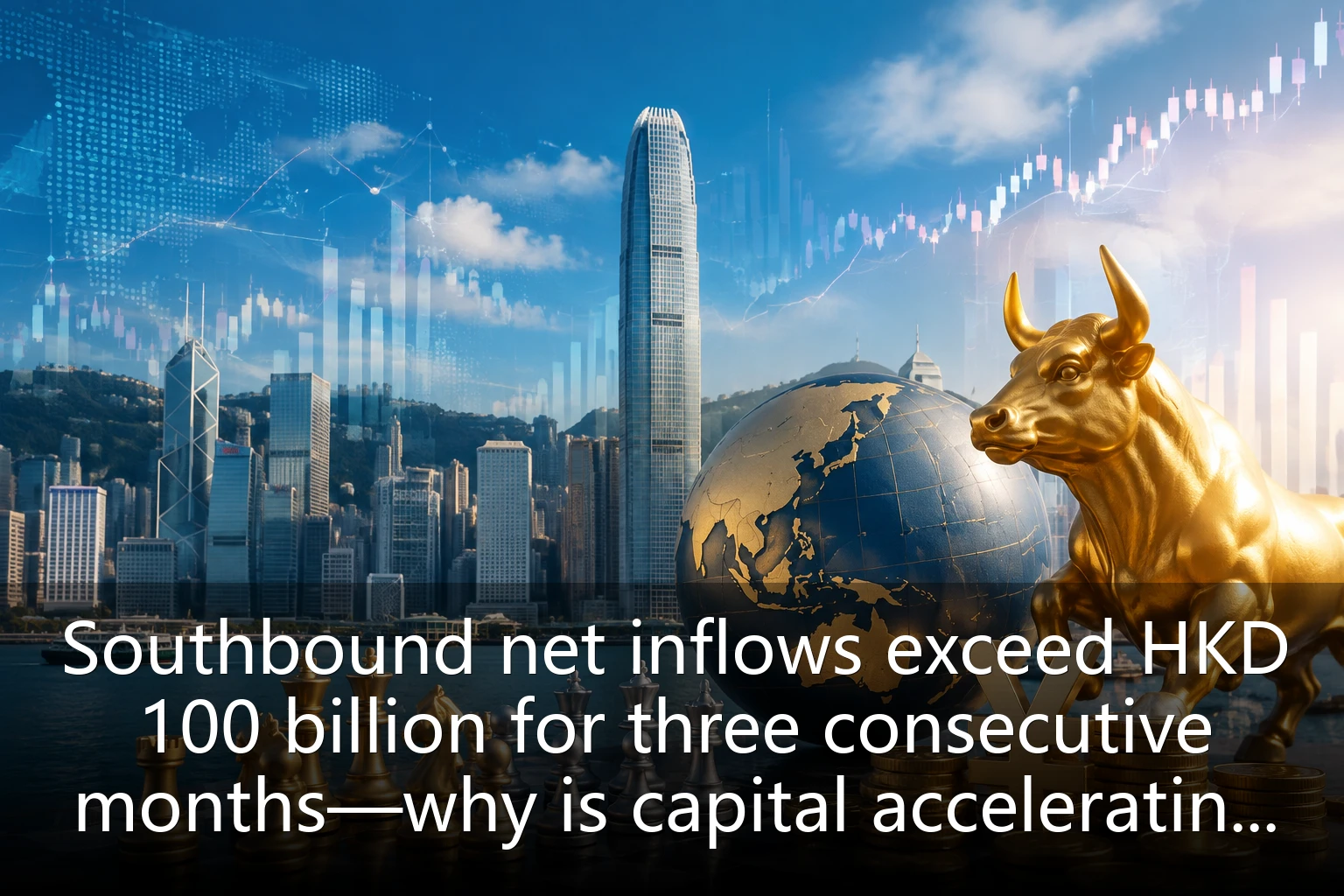
Southbound Stock Connect Inflows Accelerate, Net Buying Exceeds HKD 100 Billion for Three Consecutive Months
On August 2, 2026, according to the latest data disclosed by the Hong Kong Stock Exchange, the net southbound inflow of Stock Connect funds reached HKD 128 billion in July. This marks the third consecutive month since May that net southbound buying has surpassed the HKD 100 billion threshold. Cumulatively, total net southbound inflows for the first seven months of 2026 have exceeded HKD 680 billion, a significant increase of about 45% compared to the same period last year. This sustained surge of capital heading south has reignited deep market reflection on the core question: "Why invest in Hong Kong stocks?"
Looking at the specific structure of capital flows, the direction of this round of southbound buying shows clear divergence. Internet leaders like Tencent, Meituan, and Xiaomi continue to receive substantial net buying, while previously less popular high-dividend sectors—such as CNOOC, China Shenhua, and China Mobile—are also seeing signs of sustained capital inflows. This "barbell" allocation strategy, balancing tech growth on one side and high-dividend defensives on the other, reflects the urgent demand from mainland investors for diversified asset allocation in the Hong Kong market.
Elevated AH Premium Index Highlights Persistent Valuation Discount
As of the close on August 1, the Hang Seng AH Premium Index stood at 142.6 points. Although down from its mid-year high, it remains in the mid-to-high range of the past three years. This means that for companies dual-listed in both markets, A-shares are trading at an overall premium of over 42% compared to their H-share counterparts. For long-term value investors, the cheaper H-share listing of the same company inherently offers a higher margin of safety and greater potential return.
Taking a major state-owned bank as an example, its H-shares have long traded at a 25% to 30% discount to its A-shares, yet the difference in corresponding dividend yields is striking: the A-share yield is about 5.2%, while the H-share yield reaches as high as 7.8%. Against a backdrop of persistently low interest rates, this highly certain dividend return has become a core driver for long-term capital, such as insurance funds and pension funds, to allocate to Hong Kong stocks via the southbound channel.
Moreover, the Hong Kong market hosts a large number of high-quality mainland enterprises listed only in Hong Kong, such as internet giants Tencent, Meituan, and Kuaishou, along with numerous sub-sector leaders in consumer, pharmaceutical, and new energy sectors not listed on the A-share market. These targets represent a unique resource for investors to diversify their assets through Stock Connect and are an irreplaceable investment option compared to the A-share market.
The "Natural Hedge" Logic Amid RMB Exchange Rate Fluctuations
Since 2026, the RMB/USD exchange rate has fluctuated within the 7.15 to 7.35 range, continuously fueling demand from mainland investors for overseas asset allocation. Hong Kong stocks, being HKD-denominated assets with the HKD pegged to the USD, essentially provide mainland investors with a convenient channel for allocating "quasi-USD assets."
Given limited QDII quotas and restricted direct overseas investment channels, Stock Connect has become the most direct and compliant path for ordinary investors to achieve cross-border asset allocation. When the RMB faces periodic depreciation pressure, holding HKD assets can hedge exchange rate risk to a certain extent, which is one of the key macro logics driving sustained southbound capital deployment into Hong Kong stocks.
Furthermore, while the Hong Kong and A-share markets are highly correlated, they differ significantly in sector structure, investor composition, and liquidity environment. From a portfolio theory perspective, adding Hong Kong assets to a portfolio can effectively reduce overall volatility and improve risk-adjusted returns.
The Unique Advantage of the New Economy Value Chain in Hong Kong
The Hong Kong market has continuously pushed forward listing reforms in recent years, attracting a large number of new economy enterprises to list. In the first half of 2026, the HKEX added 42 new listings, with new economy companies accounting for over 65%, spanning cutting-edge fields such as artificial intelligence, biotechnology, new energy vehicles, and semiconductors. A significant portion of these companies are not listed in the A-share market, offering Hong Kong stock investors unique growth investment opportunities.
Taking the AI industry chain as an example, Hong Kong stocks currently encompass a complete ecosystem from upstream chip design (e.g., Horizon Robotics, Black Sesame Technologies) to midstream large model applications (e.g., SenseTime) and downstream smart hardware terminals (e.g., Xiaomi). This level of completeness and scarcity in the industry chain is difficult for the A-share market to replicate in the short term and represents one of the core attractions of the Hong Kong market for mainland investors.
Meanwhile, the HKEX has continuously optimized listing rules and trading mechanisms in recent years, including reducing the stock stamp duty to 0.1%, introducing the SPAC listing mechanism, and expanding the scope of Stock Connect eligible securities. These measures have effectively enhanced the liquidity and attractiveness of the Hong Kong market, further solidifying Hong Kong's status as an international financial center.
Hang Seng Index Technically Stabilizes as Institutional Bullishness Grows
From a technical perspective, after undergoing a deep correction from 2024 to 2025, the Hang Seng Index gradually stabilized in the first half of 2026. On August 1, the HSI closed at 21,580 points, firmly above the 21,000-point mark, with trading volume significantly higher than at the beginning of the year. Several international investment banks have recently upgraded their ratings on the Hong Kong market. In a report released in late July, Morgan Stanley raised its year-end 2026 target for the Hang Seng Index to 23,500 points, arguing that current valuations remain low and that improving corporate earnings will drive a valuation recovery.
Simultaneously, the buyback wave in the Hong Kong market continues. In July 2026, total buybacks by Hong Kong-listed companies reached HKD 38 billion, a record high for the same period. Heavyweight stocks such as Tencent, AIA, and HSBC continue to execute large-scale buybacks, which not only directly boost earnings per share but also send a positive signal to the market that management recognizes the company's intrinsic value.
Risks and Considerations for Hong Kong Stock Investment
Despite the current valuation advantages and policy tailwinds in the Hong Kong market, investors must rationally assess the associated risks. First, the Hong Kong market is significantly influenced by the global liquidity environment; factors such as changes in Federal Reserve monetary policy and geopolitical risks can trigger sharp market volatility. Second, the Hong Kong market has a higher proportion of institutional investors, leading to more efficient pricing and more pronounced stock divergence, making stock-picking ability far more critical for investment returns than in the A-share market.
Additionally, Stock Connect trading rules differ from those of A-shares, including trading hours, price fluctuation limits, and settlement cycles. Investors should fully understand these rules and implement proper risk management before participating in Hong Kong stock investment. For retail investors, indirect participation through Stock Connect ETFs or actively managed funds may be a more prudent allocation approach.
Overall, driven by multiple factors including a valuation discount, asset diversification, currency hedging, and the scarcity of new economy assets, the allocation value of the Hong Kong stock market for mainland investors continues to stand out. The three consecutive months of net southbound inflows exceeding the HKD 100 billion mark serve as a clear testament to this trend.