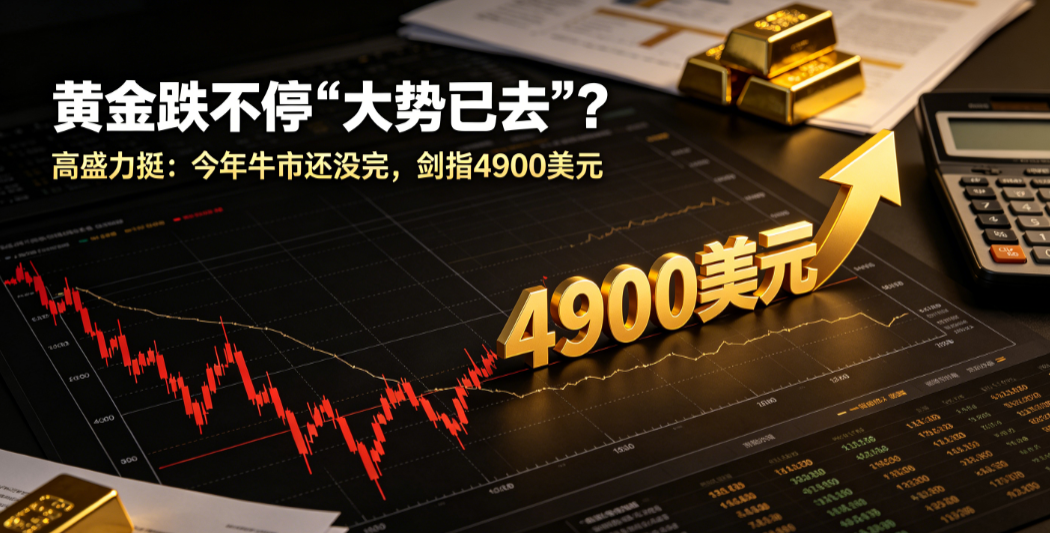
Gold’s Bull Market Is Not Over: Why the Recent Pullback May Be a Reset, Not a Reversal
Keywords: Gold, inflation, central banks, Federal Reserve, ETF demand, Goldman Sachs, monetary policy, safe-haven assets, commodity markets, reserve diversification
Introduction
Gold has been under pressure in recent months, even as the U.S. dollar has softened. The reason is not a lack of uncertainty, but rather a shift in the type of uncertainty driving markets. With tensions in the Middle East escalating again, investors are increasingly worried about renewed inflationary pressure, persistently high interest rates, and the possibility that the Federal Reserve may keep policy tight for longer than expected. Under such conditions, even traditionally supportive factors for gold have failed to translate into immediate price gains.
Yet the recent weakness in gold does not necessarily signal the end of the broader bull market. In fact, several prominent Wall Street voices argue that the current pullback may be a correction within a larger upward trend rather than the beginning of a structural reversal. Among them, Goldman Sachs remains notably constructive, stating clearly that “the gold bull market is not over.”
Goldman Sachs: The Long-Term Thesis Remains Intact
In its latest report, Goldman Sachs’ co-head of global commodity research, Samantha Dart, and her team reiterated a strongly bullish long-term view on gold. Since 2022, gold prices have risen by roughly 123%, a remarkable performance by any historical standard. Despite the recent decline, the bank argues that further upside remains possible, supported by both structural and cyclical forces.
Goldman’s most important structural argument is central bank diversification. Since Russia’s foreign reserves were frozen in 2022, many emerging market central banks have become more cautious about relying too heavily on dollar-denominated assets. This has reinforced gold’s role as a reserve asset that is free from counterparty risk and geopolitical exposure. According to Goldman, this trend is not temporary. It forms the foundation of its forecast that gold could reach $4,900 per ounce by the end of 2026.
This is a significant call, but it is not based on speculation alone. It reflects a broader rethinking of reserve management, one in which gold is increasingly viewed as a strategic asset rather than merely a tactical hedge.
Why Gold Has Fallen Despite a Softer Dollar
The recent downturn in gold has been shaped by a different macroeconomic narrative. Since late February, when conflict in Iran escalated, gold and other precious metals have come under pressure. The decline accelerated as higher oil prices pushed inflation readings upward, reviving fears that the Federal Reserve might have to maintain restrictive policy for longer—or even raise rates again before the end of the year.
This matters because gold has a unique relationship with real yields and policy expectations. It does not pay interest, so when markets begin to price in a more hawkish Fed, the opportunity cost of holding gold rises. Exchange-traded fund demand, which is highly sensitive to interest-rate expectations, tends to weaken under such conditions. In other words, even if the dollar is not strengthening meaningfully, gold can still struggle if investors believe monetary policy will stay tight.
There is also a second-layer concern: inflation may prove more persistent than markets had anticipated. Even if crude oil retreats from recent highs, stubborn inflation combined with a resilient labor market could keep policymakers cautious. That scenario would be unfavorable for non-yielding assets in the near term.
The Structural Case: Central Banks and Reserve Diversification
Goldman’s most persuasive argument lies in the structural side of the equation. A recent World Gold Council survey showed that 45% of central bank reserve managers surveyed between February and May expected to increase gold holdings over the next 12 months, a record high and up two percentage points from a year earlier.
This matters because central banks are not short-term traders. Their buying decisions are driven by strategic considerations such as reserve safety, geopolitical neutrality, and long-term portfolio diversification. If a growing number of official institutions are still adding gold, it suggests that the metal’s role in the global financial system is expanding, not contracting.
This trend is especially important in a world where trust in fiat currencies and Western fiscal sustainability is increasingly being questioned. For many reserve managers, gold offers something rare: an asset that is liquid, globally recognized, and independent of any one government’s creditworthiness.
Cyclical Headwinds May Fade
Goldman also believes that the current cyclical headwinds are temporary. The firm expects gold ETF holdings to rise gradually, in line with its economists’ view that the Federal Reserve will keep rates unchanged this year and postpone easing until the second half of next year.
If that forecast proves correct, the market’s current hawkish pricing may ultimately be overdone. Once investors begin to anticipate rate cuts again, the appeal of gold should improve. Lower policy rates would reduce the opportunity cost of holding the metal, while also weakening the argument that gold is being pressured by a strong real-rate environment.
Samantha Dart emphasized that these negative cyclical factors are likely to reverse at least partially over time. In her view, the medium- and long-term risks to Goldman’s gold forecasts remain skewed to the upside. That is because broader macro developments could eventually accelerate private investor diversification into gold, especially as concerns about fiscal sustainability in developed markets become more visible.
Other Bulls See the Pullback as an Opportunity
Goldman is not alone in its optimism. Jerry Prior, CEO of Mount Lucas Management, a hedge fund with $1.7 billion under management, has also argued that the long-term drivers behind gold remain firmly in place. In his view, one of the most important forces is the gradual erosion of the U.S. dollar’s dominance as the world’s primary reserve currency.
Prior has described the recent decline in gold as a potentially attractive entry point for long-term investors. He even anticipated the latest correction, suggesting that gold could fall below $4,000 per ounce, but that renewed oil supply and central bank reserve rebuilding would eventually bring sovereign buying back into the market. His interpretation of the move is important: this is not the start of a prolonged bear market, but rather a reset within a much larger uptrend.
Paul Williams, managing director of bullion supplier Solomon Global, has offered a similar perspective. He argues that investors should remain rational when interpreting gold’s latest price action. A nearly 30% drop from January’s record high may feel severe, but such drawdowns are not unusual in previous bull cycles.
For long-term gold holders, Williams notes, sharp corrections are part of the journey. The more relevant question is whether the fundamental reasons for owning gold have changed. In his assessment, they have not.
Conclusion
The recent weakness in gold reflects a market caught between two competing forces: on one side, geopolitical instability and inflation fears that should support the metal; on the other, expectations of a hawkish Federal Reserve that suppresses demand in the short term. For now, the second force has had the upper hand.
However, the longer-term picture remains constructive. Central bank diversification, reserve de-dollarization, fiscal concerns in the West, and the eventual normalization of monetary policy all support the case for higher gold prices over time. Goldman Sachs’ conclusion that the bull market is still intact appears rooted in a broader structural shift, not a temporary trading view.
For investors, the key takeaway is clear: gold’s recent decline may be painful, but it does not necessarily invalidate the long-term thesis. In many cases, corrections like this have historically created more attractive opportunities rather than confirmed the end of a trend.