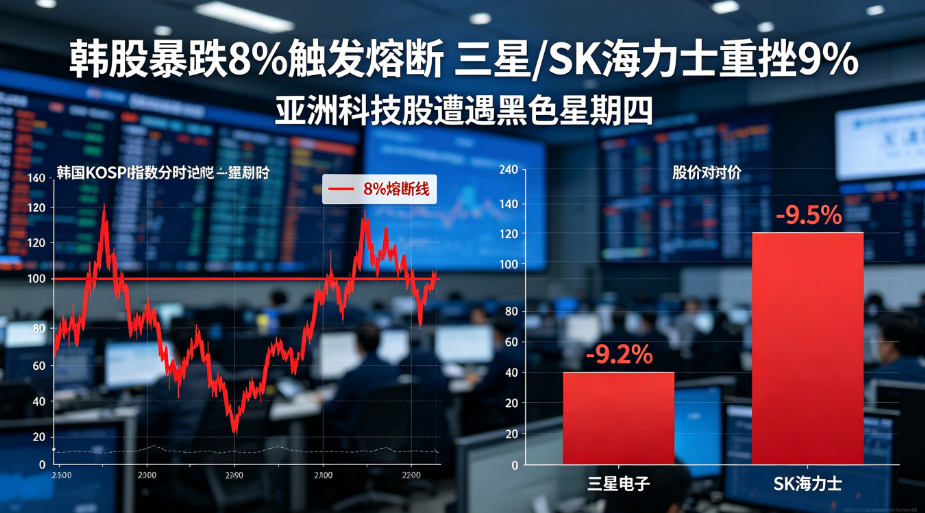
South Korea’s Chip Stocks Tumble as AI Euphoria Meets Market Reality
Keywords: South Korea stock market, Kospi, Samsung Electronics, SK Hynix, semiconductor stocks, AI sentiment, memory chips, foreign selling, OpenAI IPO, Apple pricing, market volatility
Introduction
South Korea’s equity market delivered a sharp reminder on Friday that the artificial intelligence boom, while powerful, is still vulnerable to sudden reversals in sentiment. The Kospi briefly plunged as much as 8.2%, forcing the Korea Exchange to activate a 20-minute trading halt for the second time in a week. The collapse was led by the country’s semiconductor giants—Samsung Electronics and SK Hynix—both of which fell more than 9%, as foreign investors unloaded roughly 2.7 trillion won, or about $1.7 billion, of Kospi constituents in the morning session.
The rout erased gains from the previous day, when upbeat guidance from Micron and market optimism surrounding SK Hynix’s planned U.S. listing had reignited enthusiasm for AI-related trades. But the reversal was swift. Investors began reassessing the durability of AI-driven demand after a series of developments raised doubts about pricing power, cost pass-through, and the sustainability of speculative enthusiasm. Apple’s decision to raise product prices amid memory chip shortages, along with concerns that OpenAI may delay its long-awaited IPO until next year, added to the caution.
What unfolded in Seoul was more than a one-day correction. It was a stress test for the broader AI investment thesis, especially in memory chips, where supply-demand dynamics, capital intensity, and cyclical volatility remain deeply intertwined. The selloff suggests that the market is no longer pricing AI as a one-way trade. Instead, it is beginning to confront the harder question: how much of the future AI demand story is already embedded in valuations, and how fragile is that narrative when end-market signals weaken?
A Market Shock Driven by Semiconductors
South Korea’s equity market is unusually concentrated in semiconductors, and that concentration magnifies both gains and losses when global technology sentiment shifts. Samsung Electronics and SK Hynix are not merely large-cap stocks; they are systemically important to the Kospi, the Korean won, domestic retirement savings, and foreign portfolio allocations to Asia. When these two names move sharply, the whole index can swing violently.
Friday’s decline was especially notable because it followed a powerful rally only a day earlier. Micron’s optimistic forecast had reinforced the idea that memory pricing remained on an upward trajectory and that AI infrastructure spending was still filtering through to demand for DRAM and NAND. SK Hynix’s U.S. listing plans further fueled the belief that the company could gain a premium valuation from direct exposure to American capital markets and the AI trade.
But markets do not price narratives in isolation. They continually re-evaluate them against evidence from adjacent sectors. Apple’s price increases due to memory chip shortages were interpreted in two conflicting ways. On one hand, they confirmed that chip supply remains tight enough to create cost pressure. On the other, they raised an uncomfortable question: if one of the world’s most powerful consumer electronics firms is already struggling to absorb higher component costs, how elastic is demand once those costs are passed on to customers?
That concern matters because memory chip suppliers depend on a delicate balance. Strong demand can support prices, but if end-device makers begin squeezing orders, adjusting product mix, or delaying upgrades, the pricing cycle can turn much faster than expected.
Why AI Sentiment Hits Memory Chips So Hard
The AI boom has benefited several layers of the semiconductor ecosystem, but memory chips sit at a particularly sensitive point in the value chain. AI model training and inference require massive computing infrastructure, and that infrastructure relies on high-bandwidth memory, advanced DRAM, NAND storage, and increasingly sophisticated packaging and interconnect technologies.
In theory, this should be a golden age for memory suppliers. Yet memory is not the same as logic or software. It is a cyclical, capital-intensive business where supply additions lag demand, margins compress rapidly when capacity comes online, and pricing power can disappear when inventories build. The current AI cycle has been especially potent because it combines secular demand growth with an unusually tight supply environment. But that does not eliminate the underlying cyclicality; it only postpones it.
That is why market sentiment matters so much. In a sector where future profits depend heavily on assumptions about utilization rates, product mix, and price stability, even small changes in sentiment can trigger large valuation moves. Investors are not just buying current earnings. They are buying expected earnings from a future in which AI demand continues to rise, memory content per device expands, and supply discipline remains intact.
Friday’s selloff indicates that some of those assumptions are now being questioned. If AI spending slows, if cloud providers become more selective, or if consumer device makers face margin pressure and reduce orders, the market may discover that memory earnings are more cyclical than the AI narrative suggests.
Apple as a Signal, Not Just a Customer
Apple’s reported response to memory shortages is an important signal because it demonstrates how pricing pressure can ripple through the technology stack. Apple is one of the world’s largest and most sophisticated component buyers. It has unmatched bargaining power, deep supply chain integration, and the scale to absorb shocks better than most firms. If even Apple is raising prices because memory costs are biting, then smaller hardware makers may face a far more severe squeeze.
From an industry perspective, this has two implications.
First, it validates the idea that demand for advanced memory remains strong enough to strain supply. That is constructive for suppliers in the near term. But second, it underscores the risk of demand destruction. Higher costs eventually move downstream to consumers, and that can reduce unit sales, delay upgrades, or weaken demand for premium devices. In other words, memory shortages can support chip prices only until they start undermining the broader electronics market.
For investors, the key issue is not whether memory prices are rising today, but whether they can stay elevated without damaging the ecosystem that sustains them. If demand elasticity is low in the short run, margins can expand. If not, the cycle can turn into a volume problem as quickly as a pricing problem.
OpenAI’s IPO Delay and the Psychology of the AI Trade
The market’s concern over a possible delay in OpenAI’s IPO adds another layer of complexity. OpenAI is not a chipmaker, but it has become a symbolic centerpiece of the AI trade. Its valuation, fundraising prospects, and capital market access are seen as proxies for the health of the broader AI ecosystem. A delay in its listing would not necessarily indicate weakness in AI adoption. However, it could signal that private-market exuberance is giving way to a more cautious public-market environment.
That distinction matters because the AI trade has increasingly relied on a feedback loop: powerful product narratives attract capital, capital funds more infrastructure, infrastructure drives chip demand, chip demand boosts earnings, and rising earnings justify even higher valuations. If one link in that chain becomes uncertain, the entire structure can wobble.
Fabien Yip of IG International captured the issue well by pointing out that if Apple cannot easily absorb rising input costs, then the market must seriously question both demand elasticity and the durability of memory chip margins. He also noted that an OpenAI IPO delay reflects the extent to which tech stocks remain exposed to fluctuations in retail investor enthusiasm.
That second point is important. The AI boom has not been driven solely by institutional capital or fundamental earnings revisions. It has also been powered by a strong speculative component, particularly in markets where retail investors chase high-conviction technology themes. When sentiment turns, those flows can reverse quickly, leaving highly crowded positions exposed.
Foreign Selling and Korea’s Market Structure
The scale of foreign selling in the Kospi morning session underscores how dependent South Korea’s market remains on global capital flows. A sale of 2.7 trillion won by foreign investors is not merely a trading statistic; it is a reminder that Korean equities are deeply integrated into international portfolio allocation decisions. When global risk appetite deteriorates, semiconductors are often among the first assets to be cut.
This sensitivity is amplified by Korea’s market structure. The Kospi’s performance is heavily influenced by a small number of mega-cap technology names. That creates index-level concentration risk, where a few stocks can dominate daily returns, ETF flows, and investor psychology. It also means that macro shocks, U.S. rate expectations, AI-related headlines, and chip pricing data can all have outsized effects on local markets.
In the current environment, foreign investors are likely reassessing several variables at once: the earnings trajectory of memory suppliers, the valuation premium justified by AI exposure, the impact of higher input costs on consumer electronics demand, and the probability that the AI infrastructure cycle may mature more slowly than expected. When all of these questions are unresolved simultaneously, selling tends to cluster.
The Investment Logic Behind Samsung and SK Hynix’s New Capex Plans
Another important development is the reported plan for Samsung and SK Hynix to announce new investments potentially worth hundreds of billions of dollars. On the surface, this sounds counterintuitive during a selloff. In reality, it is consistent with the strategic logic of the semiconductor cycle.
When the market rewards capacity expansion, leaders in the industry often move aggressively to secure technological positions, scale advanced processes, and prepare for the next upcycle. In AI memory, the stakes are especially high. High-bandwidth memory is now a strategic bottleneck, and companies that can deliver better performance, efficiency, and packaging integration may capture disproportionate share.
Large capital expenditures also serve a competitive function. They can lock in supply relationships with hyperscalers, support long-term roadmap credibility, and deter smaller competitors from entering the market. For Samsung and SK Hynix, investment is not simply about meeting current demand. It is about positioning for the next phase of demand, when AI inference may become much larger than training and when memory requirements could rise across data centers, edge devices, and enterprise systems.
However, there is an obvious trade-off. Heavy capex can be justified by long-term AI growth, but it can also become a burden if demand normalizes faster than expected. The history of memory semiconductors is full of boom-bust cycles in which aggressive investment eventually led to oversupply and margin compression. Investors are therefore right to scrutinize whether current investment plans are driven by durable structural demand or by the pressure to keep up with a temporarily overheated market.
What Friday’s Selloff Reveals About the AI Cycle
Friday’s plunge does not mean the AI story is broken. It does, however, reveal that the market is entering a more discriminating phase. The first phase of an innovation cycle is usually simple: capital floods into the most obvious beneficiaries. The second phase is harder: investors begin separating genuine earnings power from thematic enthusiasm.
Memory chipmakers are now in that second phase. The market is no longer willing to assume that every AI-related headline translates directly into upward revisions. Instead, it is asking whether current demand is broad-based, whether price increases can stick, whether end customers can absorb cost inflation, and whether capex discipline will eventually protect margins or instead create future oversupply.
This shift in tone is healthy from a long-term perspective. Excessively one-sided sentiment tends to produce unstable capital allocation. A more measured market environment forces companies to prove the economics behind the narrative. For Samsung and SK Hynix, that means demonstrating not just that AI demand exists, but that it can be translated into sustainable returns on capital.
Conclusion
South Korea’s sharp market decline on Friday was more than a routine correction. It was a clear sign that global AI enthusiasm, while still powerful, has become more vulnerable to evidence of cost pressure, demand fragility, and valuation fatigue. The fall in Samsung Electronics and SK Hynix highlighted the degree to which memory chipmakers are now tied to the emotional and financial rhythms of the AI trade. Apple’s pricing response, concerns over OpenAI’s IPO timing, and massive foreign selling all contributed to a broader reappraisal of the sector.
At the center of the episode is a fundamental question: can the AI boom sustain its current pace without running into the constraints of pricing, supply, and consumer demand? The answer will determine not only the future of Korean semiconductor stocks, but also the durability of the global AI equity narrative. For now, investors appear to be moving from indiscriminate optimism to selective caution. In markets like this, that shift can be the difference between a durable secular trend and a volatile speculative cycle.
If the next phase of AI growth is to justify its valuations, it will need more than enthusiasm. It will need evidence—of demand resilience, of pricing power, and of capital returns that can survive a full cycle.