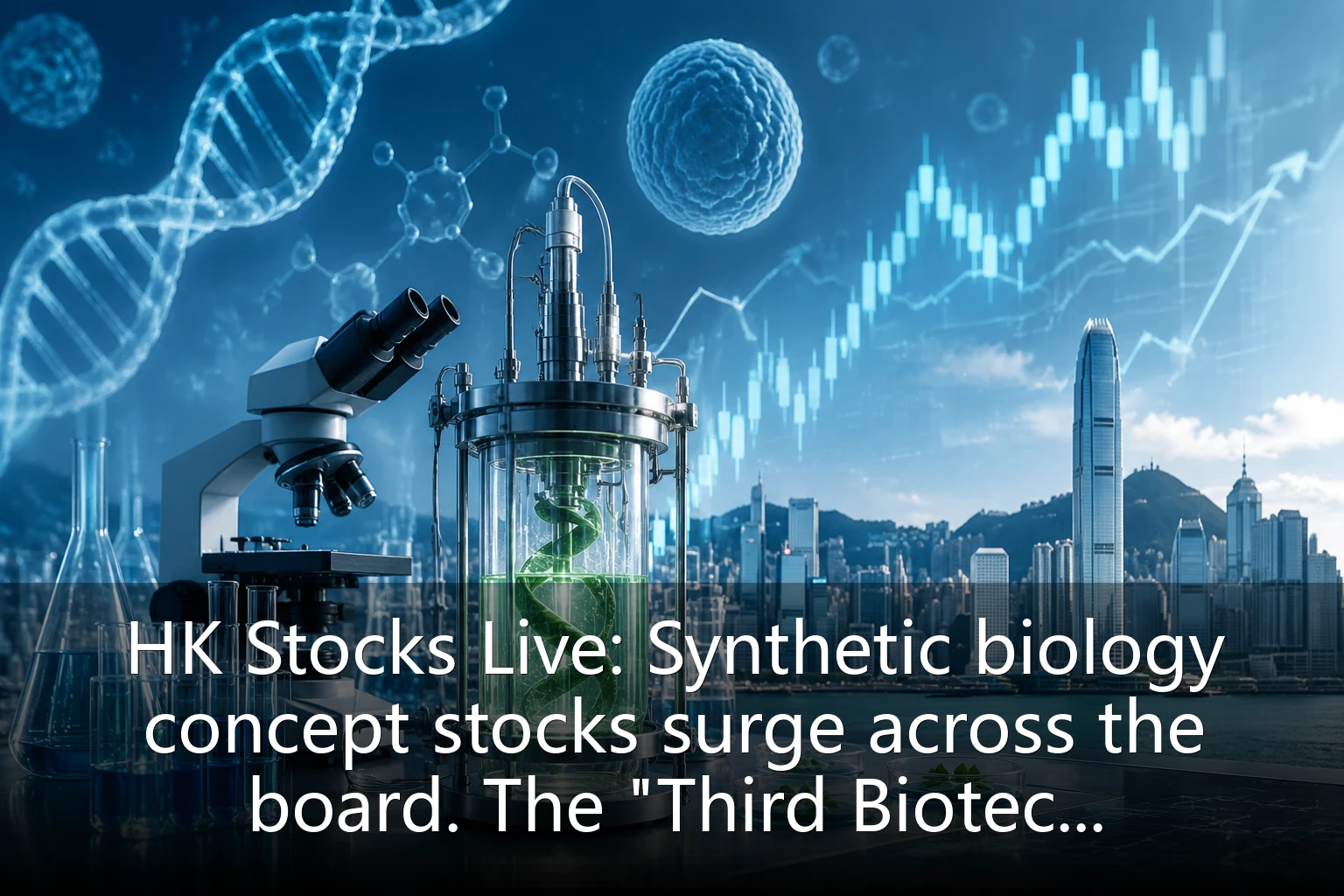
Introduction: Capital Seeks New Opportunities, Synthetic Biology Takes the Baton of "New Quality Productive Forces"
August 14, 2026: Following a period of consolidation, the Hong Kong stock market has exhibited clear signs of structural differentiation. With valuations in the AI and semiconductor sectors at high levels, astute Southbound funds and institutional investors are actively seeking new tracks with "hard tech" attributes that remain undervalued. Today, synthetic biology concept stocks surged across the board, with many related stocks seeing significant intraday gains and expanded trading volume, becoming the focal point of the market.
This is not merely simple speculation, but a concentrated market reaction to the expectation that the "Third Biotechnology Revolution" is moving from the laboratory to large-scale industrialization. With the maturation of gene editing technology, the deep application of large AI models in protein structure prediction, and the urgent global demand for green biomanufacturing, synthetic biology is gradually shedding its "concept" label and entering a golden age of "product realization." For the Hong Kong stock market, this sector movement not only signals the birth of a new investment hotspot but also foreshadows a profound reshaping of valuation logic in the biotechnology sector.
Deep Dive: What is the "Third Biotechnology Revolution"?
To understand the current fervor in the Hong Kong stock market, one must first clarify the underlying logic of synthetic biology. The industry typically regards the discovery of the DNA double helix structure in 1953 as the first biotechnology revolution, allowing humanity to understand the genetic code of life; the emergence of recombinant DNA technology in the 1970s was the second revolution, unlocking the ability to modify genes; and synthetic biology is regarded as the third biotechnology revolution.
Unlike traditional biology, which studies life through "dissection," synthetic biology is dedicated to the "engineering" construction of life systems. Through engineering principles, it designs and builds new biological parts, devices, and systems, or redesigns existing natural biological systems. Simply put, if traditional gene editing is "patching" life, then synthetic biology is "programming" life.
The Leap from "Reading" to "Writing"
The significance of this leap lies in the fact that humanity is no longer limited to reading and modifying genes, but can write biological code just like writing computer code, thereby creating entirely new functions that do not exist in nature. This allows us to use microbial cells as "micro-factories" to produce substances that originally required extraction from animals and plants or chemical synthesis, such as collagen, artemisinin, and even new types of fuel.
Dual Dividends of Cost Reduction, Efficiency Improvement, and Green Manufacturing
In the current context of 2026, against the backdrop of global supply chain restructuring and "Dual Carbon" goals, the advantages of synthetic biology are infinitely magnified. Traditional chemical synthesis is often accompanied by high pollution and high energy consumption, whereas biosynthesis features mild conditions, environmental friendliness, and renewability. More importantly, with breakthroughs in underlying technologies, the marginal cost of biomanufacturing is declining rapidly. The cost of some products has already fallen below that of traditional chemical synthesis, providing a solid economic foundation for its commercialization.
Core Drivers Behind the Sector Movement
Why did synthetic biology suddenly erupt in August 2026? By analyzing industry dynamics and the macro environment, we can identify three core drivers.
1. Deep Integration of AI and Biotechnology (Bio+AI)
Over the past two years, the explosive development of artificial intelligence technology has unexpectedly become the biggest booster for synthetic biology. Proteins are the primary carriers of life activities and the core "machines" of biomanufacturing. Previously, designing a protein with specific functions often required years of trial and error. However, with the iteration of AlphaFold and its subsequent versions, AI's ability to predict protein structures has surpassed experimental methods. In 2026, generative AI has begun to be widely used in designing entirely new protein sequences, greatly shortening the R&D cycle and lowering the barrier to entry. The acceleration of this "dry-wet loop" has led to a revaluation of the R&D pipeline value of relevant biotech companies in the Hong Kong stock market.
2. Intense Implementation of Policy Dividends and Industrial Planning
In recent years, the Chinese government has listed biomanufacturing as a strategic emerging industry for key development and has mentioned synthetic biology multiple times in the "14th Five-Year Plan" and subsequent industrial policies. In 2026, with the in-depth advancement of the national bio-economy plan, local governments have successively introduced supporting measures to support the construction of synthetic biology industrial parks and the tackling of key technologies. As a bridge connecting the Chinese and global capital markets, the Hong Kong stock market has gathered a group of biotech companies with core technical barriers. Certainty at the policy level provides a strong endorsement for these enterprises from R&D to capacity expansion, enhancing investor confidence.
3. Arrival of the Performance Realization Period
Previously, market skepticism about synthetic biology focused on "hearing the stairs but seeing no one." However, entering 2026, performance forecasts from industry leaders have frequently reported good news. Multiple products produced using synthetic biology technology have successfully achieved commercial mass production and entered high value-added markets such as cosmetics, food additives, and pharmaceutical intermediates. This shift from "storytelling" to "looking at performance" is the most direct reason for the collective strength of the sector. Capital has begun to measure the value of these enterprises using P/E (price-to-earnings ratio) rather than just P/S (price-to-sales ratio), bringing about a Davis Double Play in valuation.
Investment Logic and Industrial Chain Opportunities in the HK Market
In the Hong Kong stock market, the synthetic biology industrial chain presents a clear hierarchy. When laying out their investments, investors need to distinguish the investment logic and risk-reward ratios of different segments.
Upstream: Tools and Underlying Technology Providers
This segment mainly includes companies providing underlying technologies such as gene synthesis, gene sequencing, and bioreactors. They sit at the top of the industrial chain, similar to lithography machine manufacturers in the semiconductor chain, possessing extremely high technical barriers and pricing power. Regardless of which downstream application wins, the upstream "picks and shovels" providers can obtain stable returns. In the Hong Kong stock market, some platform companies with full-process gene synthesis capabilities are worth noting, as they benefit from the sustained growth of global biological R&D expenditure.
Midstream: The Game Between Platform and Product Companies
The midstream is the core of synthetic biology, divided into two categories: platform companies and product companies.
- Platform Companies: Possess strong strain construction and screening capabilities, monetizing by providing solutions to various industries. These companies usually have rich technical reserves and numerous pipelines but also face challenges such as high R&D investment and long profit cycles. In the current liquidity environment, the market values their ability to deliver on core pipelines more.
- Product Companies: Focus on the production of specific high-value products, such as rare ginsenosides, HMOs (Human Milk Oligosaccharides), etc. These companies have high performance elasticity; once a hit product scales up, profits will grow exponentially. The stocks leading the gains in Hong Kong today mostly belong to this category, with their logic lying in the certainty of single-product volume scaling.
Downstream: Infinite Expansion of Application Scenarios
The downstream applications of synthetic biology are extremely broad, covering medical health, agriculture, consumer goods, energy, and many other fields. For Hong Kong investors, the most intuitive opportunities lie in targets related to the "Beauty Economy" and "Healthy China." For example, recombinant collagen produced using synthetic biology technology is gradually replacing traditional animal-derived collagen, becoming a new favorite in the medical aesthetics and skincare fields. Relevant listed companies in Hong Kong are rapidly seizing market share by virtue of their advantages in purity, activity, and ethics.
Risk Warning: Cold Thinking Amidst High Valuations
Although the prospects for synthetic biology are broad, investors still need to remain clear-headed amidst the excitement. As a typical technology-intensive industry, its investment risks cannot be ignored.
First, technology transfer risk still exists. There is a huge "Valley of Death" between the micro-scale of the laboratory and the ton-scale mass production of the factory. Issues such as contamination during fermentation, unstable yields, and high extraction and purification costs can all kill a seemingly perfect project.
Second, ethical and regulatory risks are the Sword of Damocles hanging over the industry. Although the industry currently focuses mainly on non-medical fields, as technology deepens, regulatory policies involving gene editing may become stricter, which will impact the R&D progress of relevant enterprises.
Finally, valuation bubble risk needs to be guarded against. At present, with the sector's heat rising sharply, the short-term gains of some individual stocks have already overdrafted performance expectations for the next few years. Once interim report performance falls short of the market's most optimistic predictions, capital may see violent profit-taking. Therefore, distinguishing between real growth and false concepts, and sticking to the main line of performance realization, is the key to participating in Hong Kong's synthetic biology sector investment at present.
Conclusion: Seizing the Strategic Opportunities of the Biomanufacturing Era
This synthetic biology market rally in August 2026 may be just the prologue to a grand narrative. As biomanufacturing gradually replaces traditional chemical manufacturing, we have reason to believe that this field will spawn the next trillion-dollar giant. For Hong Kong investors, this is not only a short-term trading opportunity but also a strategic layout to grasp the pulse of the times.
In terms of trading strategy, it is recommended that investors pay attention to leading enterprises possessing "underlying technology platforms + scaled production capabilities + clear commercial landing scenarios," and avoid concept stocks that purely ride the hype without substantial performance support. Amidst market fluctuations, only true core competitiveness can cross cycles and create long-term value for shareholders. The wave of synthetic biology has arrived, and the Hong Kong stock market is poised to emerge with more investment targets possessing global influence in this global technology competition.